
In This Article
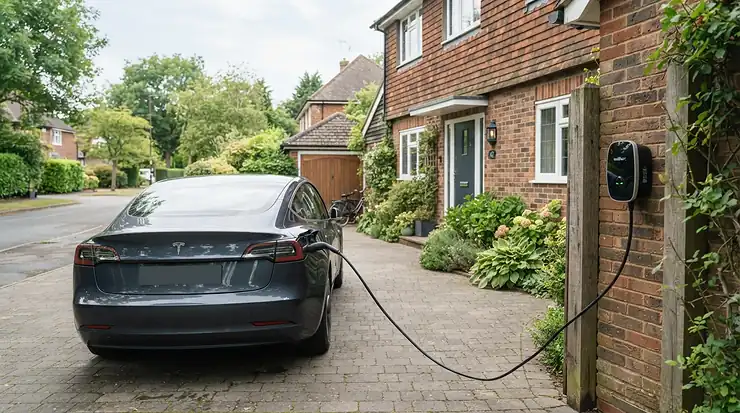
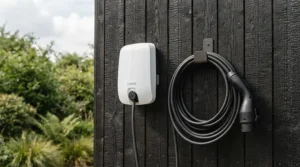
A tethered vs untethered EV charger decision sounds like the kind of thing you can settle in thirty seconds — until you’re standing on your driveway in the rain, phone in hand, trying to work out whether “the cable’s attached” actually matters as much as everyone online says it does. Here’s the short version: a tethered charger comes with its charging cable permanently fixed to the unit, so you simply lift it and plug in, while an untethered charger is really just a socket on the wall, and you supply your own separate cable every time you charge. Both do exactly the same electrical job. Neither is objectively “better.” What changes is how the decision plays out on your actual driveway, with your actual car, on a wet Tuesday in February.
We’ve dug into the real specifications, aggregated review sentiment, and genuine pricing patterns behind seven electric vehicle chargers sold in the UK, spanning proper budget kit through to the sort of unit that makes your neighbours ask questions. Along the way we’ll tackle the bits that actually trip people up: cable storage that doesn’t turn your porch into a trip hazard, what changes when your household runs more than one EV, and the practical difference between charger socket types that nobody explains properly until you’ve already bought the wrong thing.
One quick housekeeping note before we dive in: none of the prices below are exact, because Amazon pricing shifts constantly and pinning a number to a page is a fast way to mislead you. Think in ranges, check the live listing, and treat everything here as a starting point for your own research rather than gospel.
Quick Comparison Table: Tethered vs Untethered at a Glance
| Charger | Cable Format | Power | Best For |
|---|---|---|---|
| Masterplug Smart EV Home Wall Charger | Tethered (5m) | 7.4kW | Tightest budgets |
| RTSKY 7.4kW EV Charger | Tethered (5m) | 7.4kW | Bluetooth on a budget |
| WISSENERGY EV Charger Wallbox | Tethered (6m) | 7.4kW | Exposed, wet driveways |
| Aurora Seren EV Charger | Untethered (socket) | 7.4kW | Multi-EV, cable swaps |
| KioGro EV Charger | Tethered (7m) | 7kW | Shared driveways (RFID) |
| Wallbox Pulsar Plus | Tethered (5m/7m) | 7.4kW–22kW | Design-conscious buyers |
| ELEGRP Type 2 EV Charger | Tethered, portable | 7.36kW | Renters, multi-site charging |
Looking at the spread, the market’s honest answer to “tethered or untethered” is that most UK households end up with a tethered unit, and the table above reflects that reality rather than fighting it. Still, the Aurora Seren EV Charger earns its place precisely because it’s the odd one out — a genuine socketed unit for anyone who wants the flexibility a fixed cable can’t offer. If your cable format decision hinges on multiple drivers or a car that’s likely to change in the next few years, that single untethered row is worth more attention than its position in the table suggests.
💬 Found this comparison useful? A quick share helps other UK drivers make the right call too!😊
Top 7 Tethered and Untethered EV Chargers: Expert Analysis
Before we get into individual units, a word on how we picked these seven. We wanted genuine spread — proper budget kit, sensible mid-range wallboxes, and one design-led premium pick — plus a mix of tethered and untethered formats so the socket-type decision isn’t theoretical. Every spec below comes from manufacturer listings and independent review sources; every review sentiment is aggregated from what real owners have reported, not invented for effect.
1. Masterplug Smart EV Home Wall Charger — best budget tethered smart charger
The standout here is that Masterplug — a brand British households already trust for extension leads and power reels — has built a genuinely smart 7.4kW charger without the premium price tag that usually comes with app control. It ships with a 5-metre tethered Type 2 cable and control via the Sync Energy app, which is a bit like discovering your reliable local hardware shop has quietly started selling decent smartphones.
On the spec sheet, 7.4kW single-phase output means a typical 60kWh battery goes from empty to full in around eight hours — perfectly pitched for an overnight charge on a domestic supply. Built-in open-PEN protection is the detail that actually saves you money at installation, because it removes the need for a separate earth rod that many budget chargers still require, and that omission alone can add a chunk to your final bill. Based on the spec comparison with pricier tethered units, the Masterplug charger doesn’t skimp on the safety fundamentals to hit its price point; it skimps on the extras, like app polish and colour choice, instead.
Aggregated owner sentiment is mixed but broadly fair: several reviewers report smooth installs and dependable day-to-day charging, while a smaller group has flagged customer service response times when something does go wrong, particularly around app connectivity drops. This is the charger for someone who wants smart scheduling and solar-ready wiring without paying for a name that costs more just because it’s stitched onto a nicer enclosure.
Pros:
- ✅ Genuinely affordable for a smart, app-controlled tethered charger
- ✅ No earth rod needed thanks to built-in PEN protection
- ✅ 3-year warranty as standard from an established UK brand
Cons:
- ❌ App and connectivity niggles reported by a minority of owners
- ❌ Customer service response times criticised in some reviews
Prices for the Masterplug typically sit in the lower price bracket for a smart tethered charger, with fully installed packages often quoted a few hundred pounds higher — check the current price for the latest figure, but on value alone this is hard to beat if you just want reliable overnight charging without fuss.
2. RTSKY 7.4kW EV Charger — best Bluetooth control under budget
What jumps out about the RTSKY charger is the adjustable 8-level current control, running from 6A right up to the full 32A, which is a feature you’d normally expect to pay considerably more for. It comes tethered with a 5-metre Type 2 cable and controlled through Bluetooth via a companion app, so you can dial charging speed down on an ageing consumer unit that can’t handle a full 32A pull, and dial it back up once you’ve had the wiring checked.
The PEN protection and Type A plus 6mA DC-sensitive RCD combination is worth flagging in plain English: it means the unit is monitoring for both AC and DC fault currents, which is the kind of protection that used to be reserved for pricier chargers before component costs came down. What most buyers overlook about adjustable-current chargers like this one is that the flexibility isn’t just a gimmick — it’s genuinely useful if you’re charging a plug-in hybrid with a smaller onboard charger that can’t use the full 7.4kW anyway, since dialling down avoids unnecessary strain on your home’s electrics.
Reviewers on Amazon consistently mention straightforward Bluetooth pairing and describe the IP65 rating as holding up well through a full British winter, though a smaller number note that the smartphone app occasionally requires a reconnect after a firmware update. For a first-time EV owner watching every pound, this is a sensible way into smart charging.
Pros:
- ✅ Adjustable 6A–32A current suits older home wiring
- ✅ Type A + 6mA DC RCD protection built in
- ✅ IP65 rated for reliable outdoor use in UK weather
Cons:
- ❌ App occasionally needs reconnecting after updates
- ❌ Bluetooth range shorter than Wi-Fi-based rivals
Expect the RTSKY to sit at the more affordable end of the smart-charger bracket — genuinely one of the cheapest ways to get adjustable current control and app monitoring under one unit, though as ever, check the current listing before buying.
3. WISSENERGY 7.4kW EV Charger Wallbox — best for exposed, weather-hit driveways
The WISSENERGY wallbox leans hard into weatherproofing, and its IP66 rating is a genuine step up from the IP65 you’ll see on most of this list — the difference being IP66 withstands powerful water jets rather than just splashing rain, which matters if your charger sits somewhere fully exposed rather than tucked under an eave. It’s tethered with a 6-metre Type 2 cable, giving a little extra reach compared with the more common 5-metre standard.
Single-phase 32A output delivers the same 7.4kW ceiling as most of this list, but the dual RCD setup — 30mA AC alongside 6mA DC — is the detail that reviewers with electrical backgrounds tend to flag positively, since it’s a genuinely thorough fault-protection spec for the price bracket. Based on the spec comparison against budget rivals, the extra metre of cable and tougher IP rating are the two things that justify a slightly higher position than the cheapest options on this list, without pushing the price into mid-range wallbox territory.
Real-world review sentiment describes the unit as straightforward to install for a qualified electrician and dependable once running, with the longer cable specifically praised by owners parking further from their consumer unit than a standard 5-metre lead would comfortably reach. A handful of reviews mention that the companion app’s scheduling interface isn’t the most intuitive on the market, though functionally it does the job.
Pros:
- ✅ IP66 weatherproofing beats most budget rivals
- ✅ 6-metre cable offers useful extra reach
- ✅ Dual 30mA AC and 6mA DC RCD protection
Cons:
- ❌ App scheduling interface feels dated to some users
- ❌ Fewer smart-tariff integrations than premium rivals
The WISSENERGY typically prices in the budget-to-mid bracket, and given the longer cable and tougher weatherproofing, it’s worth the small premium over the very cheapest tethered options if your parking spot takes a proper battering from the elements.
4. Aurora Seren EV Charger — best untethered socket for flexibility
Here’s the one that actually earns the word “untethered” in our headline. The Aurora Seren ditches the fixed cable entirely in favour of a Type 2 socket built into the unit, which means you bring your own charging cable and plug it in each time — a Type 2-to-Type 2 lead you’ll need to buy separately if your car didn’t come with one, or simply the cable already living in your boot.
That single design choice changes more than it sounds like it should. A socketed unit like this doesn’t tie you to one connector standard forever; if you switch from a Type 2 car to something with a different inlet down the line, or if a housemate’s EV uses a different cable length than yours, you’re not stuck. Reviewers consistently note that the trade-off is an extra ten seconds of faff each charging session — plugging one end into the wall, the other into the car — which sounds trivial until you’re doing it in driving rain with your arms full of shopping. On paper this means untethered suits patient, flexibility-first buyers far better than convenience-first ones.
Aurora is an established name in UK electrical accessories rather than a newcomer, and aggregated sentiment on the Seren reflects that: solid build quality, dependable single-phase 32A charging, and few complaints about reliability. The main criticism that surfaces is one that applies to every untethered charger rather than this one specifically — buyers occasionally forget they need to source a cable separately and are caught out at installation.
Pros:
- ✅ Type 2 socket accepts any compatible cable, any length
- ✅ Future-proofs against connector or vehicle changes
- ✅ Reputable, established UK electrical brand
Cons:
- ❌ Cable not included — budget separately for one
- ❌ Slightly slower to plug in than a tethered unit
Pricing for the Aurora Seren generally undercuts tethered units with equivalent smart features, since you’re not paying for a manufactured cable — factor in the cost of a separate Type 2 cable, and the total often lands in a similar range to a mid-tier tethered charger.
5. KioGro EV Charger 7kW Type 2 — best for shared driveways with RFID access
The feature that sets the KioGro apart on a crowded spec sheet is RFID card access control, paired with a 4.3-inch LCD screen that shows live charging stats without needing your phone. On a shared driveway — housemates, extended family, or a landlord letting a tenant charge occasionally — that RFID tap-to-start function solves a genuinely annoying problem: stopping anyone who isn’t authorised from helping themselves to your electricity.
It’s tethered with a 7-metre Type 2 cable, the longest fixed lead on this list, which is worth noting if your parking arrangement means the charger has to reach across an awkward angle rather than straight to the bonnet. Single-phase 6-32A adjustable current gives the same flexibility as the RTSKY above, and the app plus RFID combination means you get two separate ways to control and monitor charging, which reviewers with multiple household drivers particularly rate.
What most buyers overlook about the LCD screen specifically is that it’s not just a nice-to-have — for anyone who finds fiddling with a phone app mid-charge annoying, being able to glance at real-time kWh delivered and estimated time remaining directly on the unit is a genuinely practical upgrade over app-only rivals. Aggregated review sentiment describes the RFID cards as reliable, with a small number of owners requesting replacement cards after losing the originals.
Pros:
- ✅ RFID access control prevents unauthorised use
- ✅ 4.3-inch LCD shows live stats without a phone
- ✅ Longest tethered cable on this list at 7 metres
Cons:
- ❌ Replacement RFID cards an extra cost if lost
- ❌ Larger unit footprint than compact rivals
The KioGro sits comfortably in the mid-range bracket, and for households where “who’s using the charger and when” is a genuine question rather than a hypothetical, the RFID feature alone can justify the step up from the cheapest tethered options.
6. Wallbox Pulsar Plus — best design-led premium tethered charger
If chargers had a fashion week, the Wallbox Pulsar Plus would be strutting down it. Designed and manufactured in Spain, it’s genuinely one of the smallest smart chargers on the UK market, and the signature LED halo ring around the connector — glowing green when ready, pulsing blue mid-charge — turns a wall-mounted utility box into something that looks almost deliberate next to your front door.
Underneath the styling sits a proper single-phase 7.4kW unit (with a 22kW three-phase version available for the small number of UK homes with three-phase supply), tethered with a 5-metre cable as standard, or 7 metres on the higher-power variant. Built-in open-PEN protection removes the earth-rod requirement here too, which keeps installation costs down despite the premium unit price. The myWallbox app is consistently rated as one of the most intuitive on the market — reviewers repeatedly single out the Power Boost feature, which overrides any active schedule for an instant full-speed top-up when you need to leave in a hurry.
Here’s the honest bit, though: the spec sheet won’t tell you this, but genuine Amazon buyer reviews flag customer support responsiveness as the Pulsar Plus’s weak point when something does go wrong — a pattern echoed enough across independent reviews that it’s worth building into your decision rather than dismissing as a one-off. It’s tethered-only, no socketed version reaches UK retail, so if flexibility matters more to you than looks, this isn’t your charger.
Pros:
- ✅ Compact, genuinely stylish design with LED status ring
- ✅ myWallbox app rated among the most intuitive available
- ✅ No earth rod required, keeping install costs down
Cons:
- ❌ Customer support response times a recurring complaint
- ❌ Tethered only — no untethered version exists
The Wallbox Pulsar Plus typically commands a premium over budget tethered rivals, though its price has come down notably from earlier generations — check the current listing, since this is a charger where the price bracket has shifted more than most over the past couple of years.
7. ELEGRP Type 2 EV Charger — best portable charger for renters and multi-site charging
The ELEGRP breaks the mould of this list by not being a wall-mounted unit at all. It’s a portable EVSE with a fixed Type 2 connector at one end and a CEE 32A commando industrial plug at the other, adjustable current control, and a built-in scheduling timer — the kind of charger you keep in the boot rather than bolt to a wall.
For renters who can’t install a permanent wallbox, or anyone who regularly charges at more than one address — a static caravan, a second property, a relative’s driveway with a suitable commando socket already fitted — this is the practical answer that a fixed wallbox simply can’t provide. The IP67 rating is the toughest weatherproofing figure on this entire list, rated for full submersion resistance rather than just heavy rain, and the working temperature range down to -25°C means it won’t quit on you during a proper cold snap. Reviewers consistently note that build quality feels sturdy for a portable unit, with the carry case included in most listings making it genuinely practical to sling in the boot.
The trade-off, and it’s worth being blunt about this, is that it needs a compatible CEE commando socket to plug into, which most UK homes don’t have without additional electrical work — so this isn’t a straightforward replacement for a wallbox, it’s a complement to one, or a solution for a specific multi-site charging need.
Pros:
- ✅ Fully portable — genuinely usable at multiple locations
- ✅ IP67 rating, the toughest weatherproofing on this list
- ✅ Adjustable current and built-in scheduling timer
Cons:
- ❌ Requires a CEE commando socket, not a standard plug
- ❌ Not a substitute for a permanent home wallbox
Portable units like the ELEGRP sit well below wallbox pricing across the board, making it an easy secondary purchase rather than a primary charging solution — a smart add-on if your household already has one of the wall-mounted chargers above.
Top 7 Chargers: Full Spec Comparison
| Charger | Cable Format | Cable Length | Power | Warranty | Best For |
|---|---|---|---|---|---|
| Masterplug Smart EV Home Wall Charger | Tethered | 5m | 7.4kW | 3 years | Tight budgets |
| RTSKY 7.4kW EV Charger | Tethered | 5m | 7.4kW | Varies by seller | Bluetooth control |
| WISSENERGY EV Charger Wallbox | Tethered | 6m | 7.4kW | Varies by seller | Wet, exposed driveways |
| Aurora Seren EV Charger | Untethered | N/A (socket) | 7.4kW | Manufacturer standard | Multi-EV flexibility |
| KioGro EV Charger | Tethered | 7m | 7kW | Varies by seller | Shared driveways |
| Wallbox Pulsar Plus | Tethered | 5m/7m | 7.4kW–22kW | 3 years | Design-conscious buyers |
| ELEGRP Type 2 EV Charger | Tethered, portable | 6m | 7.36kW | Varies by seller | Renters, multi-site |
The pattern worth reading here isn’t power output — every single unit tops out around the 7.4kW single-phase ceiling that suits the vast majority of UK homes, so charging speed genuinely isn’t the differentiator most buyers assume it will be. Warranty length and cable format are where the real trade-offs sit: the two three-year-backed units, the Masterplug and the Wallbox Pulsar Plus, come from more established manufacturers, while the newer entrants compete harder on adjustable current control and weatherproofing instead. If you’re torn between two similarly priced options, let the cable format decision — not the kW figure — be your tiebreaker.
Practical Usage Guide: Installing and Living With Your Charger
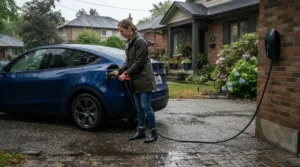
Getting a tethered or untethered EV charger from delivery box to functioning wallbox is entirely down to a qualified electrician — none of these units are legal DIY installs in the UK, and every listing above assumes professional fitting as standard. What you can control is the run-up and the first month afterwards. Before the installer arrives, measure the actual distance from your proposed mounting point to where the car’s charging port sits when parked normally, not where you assume it sits, since that single measurement determines whether a 5-metre tethered cable will comfortably reach or leave you stretching awkwardly every single day.
Once it’s live, the most common first-30-days mistake is over-scheduling: new owners set an ambitious overnight charging window through the app, then get frustrated when the car isn’t ready because the schedule didn’t account for a lower state of charge than usual. Give the app’s default settings a week before fine-tuning them. Similarly, resist the urge to max out adjustable-current models like the RTSKY or KioGro to their full 32A immediately — start a notch or two below maximum for the first few charges and confirm your consumer unit handles it without tripping, particularly in older properties.
Maintenance is refreshingly low for all seven units here: wipe the enclosure occasionally, check the cable (tethered models) or your own lead (untethered models) for nicks or wear every few months, and keep the charging port’s rubber cover seated properly when not in use to stop water ingress. None of this requires tools or expertise — just the same five minutes you’d spend checking your tyre pressures.
Cable Storage: Keeping Your Charging Cable Tidy and Safe
Cable storage sounds like a minor afterthought until you’re the person who’s driven over their own charging lead, or the person whose neighbour has tripped on it in the dark. For tethered chargers, most manufacturers — including the Masterplug and WISSENERGY units above — build a simple wrap-around hook or cradle into the unit itself, and using it religiously rather than “just for now” leaving the cable coiled on the ground is the single easiest way to extend a cable’s working life by years rather than months.
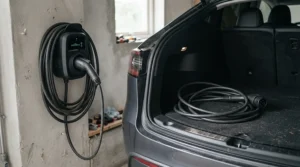
Untethered setups like the Aurora Seren have a slightly different cable storage problem: you’re now responsible for a separate lead that has to live somewhere between charges. A wall-mounted cable holster — a simple bracket that holds the coiled cable off the ground — solves this properly, and they’re inexpensive enough that skipping one to save a few pounds rarely makes sense once you’ve seen what a winter of ground-level storage does to the connector’s rubber seals. What most buyers overlook about cable storage specifically is that it isn’t really about tidiness; it’s about avoiding the two genuine failure points for any EV cable, which are moisture ingress at the connector and repeated flex-fatigue at the strain relief where the cable meets the plug.
If you’re charging somewhere genuinely exposed to the weather, a weatherproof cable bag or a dedicated outdoor cable box adds real protection beyond what a basic hook provides, and it’s a sensible pairing purchase alongside any of the untethered or portable units on this list, including the ELEGRP.
Tethered and Untethered Chargers for Multi-EV Households
Multi-EV households are where the tethered-versus-untethered question stops being theoretical and starts having genuine financial and practical weight. If you’re a two-car family with a Type 2 hatchback and, say, an older plug-in hybrid that still uses a Type 1 connector, a tethered Type 2 charger like the Masterplug or Wallbox Pulsar Plus simply can’t serve the second car without an adapter cable bridging the gap — workable, but an extra step every single time.
Consider a household running two modern EVs, both Type 2, parked in different spots on the drive. An untethered charger such as the Aurora Seren, paired with two separate cables — perhaps different lengths to suit each parking spot — lets both drivers use the same wall unit without either needing to shift the other’s car first, provided you’re not charging both simultaneously on a single-charger setup. Compare that with a fixed 5-metre tethered cable that only reaches one of the two parking positions comfortably, and the flexibility argument for going untethered becomes concrete rather than abstract.
For households likely to change one car for a different connector standard within the next few years — swapping an older Type 1 plug-in hybrid for a newer Type 2 EV, for instance — the case for untethered strengthens further, since you’re not locked into a fixed cable that assumes today’s connector will still be right in three years. If your multi-EV setup genuinely is two drivers sharing one charger and one connector standard, a tethered unit with a slightly longer cable, like the 7-metre KioGro, can actually work out simpler than juggling loose cables between two people.
Charger Socket Type Explained: Type 1 vs Type 2
What is a charger socket type, in the context of buying a home EV charger? It refers to the physical connector standard your charging cable uses to plug into your car — and in the UK, that distinction almost always comes down to Type 1 versus Type 2, with Type 2 being the standard fitted to virtually every EV sold here since around 2018.
Type 2, formally the Mennekes connector, uses a seven-pin design that carries both power and the communication signal between car and charger, supporting single-phase speeds up to 7.4kW and three-phase up to 22kW on units like the higher-spec Wallbox Pulsar Plus. It’s the connector every tethered charger on this list is built around, and it’s what you’ll find built into every untethered charger’s socket too, waiting for your own Type 2-to-Type 2 cable. Type 1, sometimes called the J1772 connector, has five pins and appears mainly on older or imported EVs — early Nissan Leaf models being the classic UK example — and supports AC charging only, without the three-phase capability Type 2 offers.
Here’s the practical upshot for your buying decision: if your car uses Type 1, a tethered Type 2 charger is the wrong purchase entirely, since the fixed cable simply won’t fit your car’s inlet. An untethered charger with a Type 2 socket, paired with a Type 1-to-Type 2 cable, solves this — which is precisely the scenario where the Aurora Seren‘s socketed design earns its keep over any of the six tethered units on this list. If you’re planning to keep your current EV or PHEV for several more years and it’s a Type 1 vehicle, factor that connector reality into your charger choice before anything else on this page.
How to Choose Between a Tethered and Untethered EV Charger
Working through this decision methodically beats guessing, so here’s the reasoning we’d walk a friend through:
- Check your car’s connector type first. If it’s Type 1, lean untethered, since a fixed Type 2 cable won’t physically fit.
- Count your drivers and vehicles. One car, one driver, same parking spot every night points firmly towards tethered convenience.
- Measure the distance to your parking spot. A 5-metre tethered cable that doesn’t comfortably reach is a daily annoyance you’ll feel for years.
- Weigh theft risk against your street. A tethered cable left dangling is a more visible, more valuable target than a coiled cable tucked away between charges.
- Think about your next car, not just this one. If a connector-standard switch is plausible within five years, untethered future-proofs you against it.
- Factor in the cost of a separate cable. Going untethered means budgeting for a Type 2-to-Type 2 lead if your car didn’t already come with one.
- Consider who else uses the space. Shared driveways and multi-EV households, as covered above, tend to favour the flexibility untethered offers.
Run through those seven questions honestly and most buyers land on an answer fairly quickly — and if you’re still torn after all seven, that’s usually a sign either option will serve you reasonably well, so lean towards whichever costs less for your specific setup.
Common Mistakes When Buying an EV Home Charger
The single most common mistake we see is buyers focusing entirely on kW output and completely ignoring cable length or format, then discovering post-installation that a tethered unit’s fixed lead doesn’t reach their actual parking spot. Every charger on this list tops out around the same 7.4kW single-phase ceiling, so obsessing over a marginal power difference between two units while ignoring cable reach is optimising for the wrong variable entirely.
A second recurring error is assuming installation cost is separate from, and unrelated to, which charger you choose. It isn’t: units without built-in PEN protection, like some older or budget models, often require an additional earth rod, which can meaningfully increase your final installed price regardless of how cheap the unit itself looked on the box. Reviewers consistently flag being caught out by this after comparing unit prices without checking installation requirements first.
Third, and this applies specifically to untethered buyers: forgetting to budget for a separate charging cable. It’s an easy oversight, since the charger itself is the headline purchase, but a Type 2-to-Type 2 cable is a genuine additional cost that can close much of the price gap between an untethered unit and a comparable tethered one — factor it in before you compare prices, not after.
What to Expect: Real-World Performance
On paper, every charger on this list delivers similar numbers — 7.4kW, roughly 25-35 miles of range added per hour of charging, a full charge overnight. In practice, real-world performance is shaped far more by your car’s onboard charger, your home’s electrical supply, and the weather than by which of these seven units you’ve bolted to the wall.
What the spec sheet won’t tell you, but reviewers note fairly consistently, is that charging speed can dip slightly in very cold weather as the battery management system moderates the rate to protect cell health — this applies to every EV regardless of which charger you use, so don’t mistake a slower January charge for a faulty unit. Similarly, plug-in hybrids with smaller onboard chargers, often capped around 3.6kW, won’t benefit from the full 7.4kW output these chargers provide; this is where adjustable-current models like the RTSKY and KioGro genuinely earn their keep, letting you match output to what your vehicle can actually use rather than wasting capacity.
Tethered versus untethered makes essentially zero difference to charging speed itself — both formats deliver identical electrical performance once connected. The difference you’ll actually notice day to day is entirely in the plugging-in ritual: grab-and-go with tethered, a brief extra step with untethered, repeated every single charge for as long as you own the unit.
Long-Term Cost & Maintenance
Total cost of ownership for a home EV charger extends well beyond the unit price, and it’s worth running the full sum before comparing any two chargers head to head. Installation typically forms the largest single line item, and — as the OZEV chargepoint grant guidance from gov.uk confirms — eligible renters and flat owners can currently claim government support towards installation costs, which can meaningfully shift the value calculation in favour of units on the OZEV-approved list.
Beyond installation, running costs come down almost entirely to your electricity tariff rather than which charger you own, since every unit here delivers the same 7.4kW ceiling regardless of brand. Smart-scheduling chargers with strong tariff integration, like the Masterplug and Wallbox Pulsar Plus, can pay for their smart features over time by consistently timing charges to your cheapest off-peak rate, which on many EV-specific tariffs can represent a genuinely significant saving across a year of regular charging compared with charging at standard daytime rates.
Maintenance costs across this list are low and fairly uniform — these are largely solid-state units with minimal moving parts, and the main ongoing cost, where relevant, is cable replacement. A tethered charger’s cable is generally harder and pricier to replace than simply buying a new lead for an untethered unit, which is a long-term cost worth weighing if you expect to put serious annual mileage through your charger.
Safety, Regulations & Compliance Guide
Every charger on this list requires professional installation by a qualified, competent electrician, and this isn’t a suggestion — it’s a legal and safety requirement under UK wiring regulations. Installers should be registered with a recognised competent person scheme such as NICEIC, reflecting the specific technical requirements set out in BS 7671 Section 722 alongside the IET Code of Practice for Electric Vehicle Charging Equipment Installation. There’s no meaningful safety difference between a correctly installed tethered unit and a correctly installed untethered one — the format you choose is a convenience decision, not a safety one.
Connector standards matter for compliance too, and the Zap-Map guide to UK charging connectors is a genuinely useful reference if you’re unsure which standard your specific vehicle uses before you commit to a tethered charger’s fixed connector. Getting this wrong is one of the costliest mistakes on this entire page, since a mismatched tethered cable means the whole unit is unusable for your car.
On the financial side, the government’s EV chargepoint grant scheme — administered through OZEV and detailed on gov.uk — currently offers support towards installation costs for eligible renters and flat owners with dedicated off-street parking, provided the chargepoint and installer are both on the approved list. It’s worth checking eligibility before booking an installation, since claiming the grant retrospectively generally isn’t possible once work has started.
Buyer’s Decision Framework
If you want the short version distilled into a checklist rather than paragraphs, here’s the logic:
- If you have one car, one driver, and a fixed parking spot within cable reach, choose tethered — the Masterplug or RTSKY cover this at the lowest cost.
- If your driveway takes a genuine battering from the weather, choose a higher IP-rated tethered unit like the WISSENERGY.
- If you run multiple EVs or expect your car’s connector standard to change, choose untethered — the Aurora Seren is built for exactly this.
- If several people share access to your charger, choose a unit with RFID or access control, like the KioGro.
- If design and app experience matter as much as function to you, and budget allows, choose the Wallbox Pulsar Plus.
- If you rent, move between properties, or need charging away from a fixed wallbox, choose a portable unit like the ELEGRP alongside, not instead of, a home charger.
Frequently Asked Questions
❓ Is a tethered or untethered EV charger better for a UK home?
❓ Can I add a cable to an untethered EV charger later?
❓ Do tethered chargers cost more than untethered ones?
❓ What charger socket type do most UK electric cars use?
❓ Is cable storage a problem with untethered EV chargers?
Conclusion
If there’s one genuine takeaway from comparing these seven chargers side by side, it’s that the tethered vs untethered EV charger decision has almost nothing to do with charging speed and almost everything to do with how your household actually lives day to day. Every unit here delivers a broadly similar 7.4kW ceiling; what separates them is cable reach, weatherproofing, access control, design, and — fundamentally — whether a fixed cable fits your routine or gets in its way.
For most single-EV households with a consistent parking spot, a tethered charger like the Masterplug or RTSKY genuinely is the simpler, cheaper, more convenient choice, and there’s no shame in picking the boring, sensible option that just works every morning. For multi-EV households, shared driveways, or anyone eyeing a connector-standard change down the line, the Aurora Seren‘s untethered flexibility earns its higher initial faff in exchange for genuine long-term adaptability. Wherever you land, cross-reference your car’s connector type, your realistic parking distance, and your household’s actual charging habits against the seven options above before committing — the right charger is the one that matches how you’ll actually use your driveway, not the one with the flashiest spec sheet.
Recommended for You
- Best Home EV Charger UK: 7 Top Picks & OZEV Grants (2026)
- Home Energy Monitor For Solar Panels: 7 Best UK Picks (2026)
- Solar Battery Monitoring Add-On: 7 Best UK Picks (2026)
Disclaimer: This article contains affiliate links. As an Amazon Associate, I earn from qualifying purchases. If you purchase products through these links, we may earn a small commission at no additional cost to you.
✨ Found this helpful? Share it with your friends! 💬🤗
