
In This Article
Picture it. It’s 9pm and your battery is flirting with 11%. The nearest rapid charger has a queue and a fault light. Your sister’s driveway, forty minutes away, has a perfectly ordinary three-pin socket on the garage wall. That is the moment a portable EV charger cable stops being an accessory and becomes the hero of the story. It’s the sort of portable EV charger cable that lives in the boot for months, then earns its keep in one evening.
The public network is far bigger than it used to be. Official figures show 119,080 public EV chargers in the UK on 1 April 2026. Even so, plenty of journeys end at a holiday cottage, a relative’s house or a car park with no charger in sight. A 3-pin granny charger plugs into a standard UK socket at one end and your car’s Type 2 inlet at the other. It’s slow, unglamorous and quietly brilliant.
This guide compares seven real models you’ll find on amazon.co.uk, from tidy budget cables to a premium do-it-all unit. I’ve built the analysis from published specifications, independent tests such as Parkers’ roundup, and safety guidance from UK bodies. Where I couldn’t verify genuine customer-review themes for a product, I say so rather than guess. You’ll also find plain-English sections on trickle charging, on building a sensible backup charging solution, and on the safety rules that matter when a 13A socket works for hours instead of minutes.
One tip before you spend anything: check your boot. Many manufacturers supply a Mode 2 cable with new cars, so you may already own a basic one. If you want longer reach, a timer or better weatherproofing, read on. All prices below are ranges and may vary.
Quick Comparison: Portable EV Charger Cable Picks at a Glance
| Model | Standout Feature | Best For |
|---|---|---|
| Masterplug EVCM221010-MP2 | 10m reach, IP66 when connected | Best all-rounder for most drivers |
| Ampwerk 10M | Fixed 10A output with timer | Cautious buyers on a budget |
| EzGoGo 10m 3kW | Selectable 6/8/10/13A | Adjustable power on a budget |
| Tera P03 | Wall holder and bag included | Tidy home setups |
| Vorsprung 8m | Digital screen, 8/10/13A | Value seekers wanting a proven brand |
| dé EV Charger 10m | Phone app scheduling | Off-peak tariff users |
| Juice Booster 2 | Up to 22kW with adapters | Travellers and future-proofers |
Looking at the comparison above, the Masterplug EVCM221010-MP2 is the safest all-round choice for most drivers, while the EzGoGo 10m 3kW offers the most adjustability for the money. If you want to schedule charging from the sofa, the dé EV Charger 10m is the one to watch. If your ambitions stretch beyond a 13A socket, the Juice Booster 2 plays in a different league. Budget buyers should note that the Ampwerk 10M trades adjustability for a simple fixed 10A setting, which is often the more conservative choice on older wiring.
💬 Just one click — help others make better buying decisions too!😊
Top 7 Portable EV Charger Cable Options: Expert Analysis
Each entry covers specs in plain English, who the product suits and the honest trade-offs. Review sentiment comes from independent tests and retailer listings, never from invented quotes.
1. Masterplug EVCM221010-MP2 — the dependable 10-metre all-rounder
Masterplug is a name British DIY aisles have trusted for decades, and this Mode 2 model is where that cable-making pedigree meets EV charging.
It delivers up to 10A, or 2.4kW, which the manufacturer puts at roughly 8 miles of range per hour. That’s modest on paper, but 10A is a sensible ceiling for a socket that may run for hours. The control box is rated IP66 when connected to the car and IP55 when unplugged. A drizzly driveway is fine; a puddle is not. It also carries 30mA AC and 6mA DC residual-current protection.
Based on the spec comparison, ten metres solves the classic garage-socket, nose-out-parking problem. The fixed output means no fiddling, which suits less technical drivers, though you lose the lower “gentle” settings some rivals offer. The listing also mentions a delay-charging function for off-peak tariffs.
Parkers named it their editor’s pick. They praised the build and safety features, and their main gripes were slow charging and a marginally weaker IP rating than some rivals. I couldn’t independently verify Amazon UK review themes, so treat that as expert sentiment rather than crowd sentiment.
Pros:
- ✅ Ten metres of reach handles awkward sockets
- ✅ AC and DC leakage protection built in
- ✅ Clear LCD shows charging status
Cons:
- ❌ 2.4kW ceiling means slow top-ups
- ❌ Listing states a one-year warranty; check current terms
Around £100-£150 at the time of research; check current price. That’s fair value for the safety spec.
2. Ampwerk 10M — simplest fixed-10A budget option
Sometimes the best feature is the one you can’t change.
The Ampwerk 10M delivers a fixed 2.3kW (10A) through a Type 2 to 3-pin cable, rated IP65, with a carry bag and a 2-8 hour timer. It’s a UK-designed brand, sold by Ampwerk and fulfilled by Amazon, with a one-year warranty. In practice, 10A leaves headroom below a socket’s 13A rating, so the plug should run cooler than it would at maximum load. IP65 means dust-tight and resistant to water jets. Rain is fine; submersion is not.
The listing describes the timer as controlling how long charging runs. Check the manual to see whether it delays the start or simply limits the duration, because that changes how useful it is on a cheap-rate tariff. Either way, the timer helps you cap a session so you’re not pulling load all night.
Here’s what to weigh. This is a sensible pick for older properties or cautious owners who’d rather not choose between 6A and 13A. It’s less suited to those who want a quick 13A boost on an emergency stop.
I couldn’t find enough verifiable review detail to summarise fairly, so lean on the warranty and Amazon’s returns rights.
Pros:
- ✅ Fixed 10A keeps things simple and cool
- ✅ Ten-metre cable with carry bag included
- ✅ UK-based support and brand
Cons:
- ❌ No selectable current settings
- ❌ Only a one-year warranty
Budget-tier pricing at the time of research, well below the premium unit; check current price. It offers good value if you value simplicity.
3. EzGoGo 10m 3kW — most adjustable for the money
The EzGoGo earns its place by letting you choose 6A, 8A, 10A or 13A, which is rare at this end of the market.
At 13A you get around 3kW. At 6A you get roughly 1.4kW, which is the gentle setting for a doubtful socket. It’s rated IP65, includes a 1-12 hour delayed-charging option, and Amazon flags recycled-material sustainability credentials on some listings. In real terms, 13A adds roughly 10 miles of range per hour, depending on your car’s efficiency.
Adjustability is the selling point, but use it wisely. Parkers cautions elsewhere that sustained 13A isn’t ideal, and independent guides say to choose the current the installation can genuinely support. My reading is that 8A or 10A suits overnight sessions, with 13A reserved for short top-ups on a healthy circuit.
This product is sold in several lengths, including a 15-metre version, and appears widely on Amazon UK. I couldn’t verify consistent review themes for a specific variant, so check recent reviews for the length you want.
Pros:
- ✅ Four selectable current settings
- ✅ Delay timer for off-peak charging
- ✅ Multiple cable lengths available
Cons:
- ❌ 13A tempts sustained heavy loads
- ❌ Review themes are hard to verify across variants
Budget to lower mid-tier at the time of research; prices vary by length. It’s strong value if you’ll actually use the current settings.
4. Tera P03 — best kit in the box
The Tera P03 bundles the accessories other brands sell separately.
It offers 6A, 8A, 10A and 13A settings from a 200-240V supply, up to 3kW, in a 6-metre cable with an LCD, a 5-hour delay timer and IP66 weatherproofing. The box adds a cable holder and storage bag. It’s CE certified, with protection against overcurrent, overvoltage, overheating, lightning and short circuits.
The practical value is in that wall holder. Hanging the connector off the ground keeps it out of puddles and grit, which matters more than a spec-sheet number. Six metres is shorter than the ten-metre rivals, so measure from your socket to the charging port before buying.
For a home setup where the socket and parking bay sit close together, this is a tidy solution. It suits renters who want something that looks organised and stores neatly. The lightning and IP66 claims are welcome, though I’d still unplug during storms.
I couldn’t verify meaningful Amazon review themes for this exact model, so there’s no crowd verdict to report. Related Tera listings sell in several variants, so read the product title carefully.
Pros:
- ✅ Wall holder and storage bag included
- ✅ IP66 weather protection
- ✅ Four adjustable current levels
Cons:
- ❌ Six metres limits reach
- ❌ Sibling models make listings confusing
Around £100-£140 at the time of research; check current price. It’s good value for the accessories alone.
5. Vorsprung 8m — Parkers’ budget pick with a digital screen
The Vorsprung makes its case with independent testing rather than marketing.
The Amazon listing describes an 8-metre cable with a controllable digital screen, 8A, 10A or 13A settings and a free carry case. Parkers tested the 10-metre 10A version and named it their best budget pick. They noted a flame-retardant, impact-resistant ABS body, an operating range of -25°C to +55°C, and protection against overcurrent, over- and under-voltage, leakage and overheating.
The catch is an IP55 rating on the model Parkers tested, lower than the IP65-IP67 ratings elsewhere. In practice IP55 handles splashes and rain well enough if the control box hangs clear of standing water, but it doesn’t inspire confidence in a flood-prone drive. Confirm the rating on the specific 8-metre listing before buying.
Here’s the analytical take. If you want a name that has been through a UK motoring-site test and you’ll mostly charge under cover, this is a solid pick. If you’ll leave it out on a wet driveway all winter, consider a higher-rated rival.
Parkers’ sentiment was positive on safety and design and negative on weather rating. That’s expert sentiment rather than crowd sentiment.
Pros:
- ✅ Independently tested and named budget pick
- ✅ Wide operating temperature range
- ✅ Digital screen and carry case
Cons:
- ❌ IP55 is the weakest rating here
- ❌ Not the fastest option available
Budget to lower mid-tier at the time of research; check current price. It’s good value for covered charging.
6. dé EV Charger 10m with App — smartphone scheduling from a granny cable
Most 3-pin granny charger cables are dumb by design. The dé EV Charger isn’t.
The listing describes 3.12kW output at 240V/13A, IP66 protection, 6-13A adjustment and a 0.5-8 hour delay timer. Control comes through the Tuya/Smart Life app, and the built-in protection is Type A RCD at 30mA AC plus 6mA DC. That protection is worth having because not every domestic socket circuit is guaranteed to be RCD-protected, and Electrical Safety First warns older wiring may struggle with overnight loads.
The app is the real prize. Start and stop charging from indoors, schedule around an off-peak window, and avoid trudging outside in slippers. But an app depends on Wi-Fi reaching the socket, and a detached garage or driveway wall may sit outside your router’s range. Test the signal before relying on the schedule.
This suits tech-comfortable drivers on time-of-use tariffs who want granny-cable simplicity with some intelligence. It’s overkill if you only charge in emergencies.
I couldn’t verify sufficient Amazon review themes for this model, so read recent reviews on the app’s reliability.
Pros:
- ✅ App scheduling and remote control
- ✅ Type A RCD with 6mA DC detection
- ✅ IP66 rating and ten-metre cable
Cons:
- ❌ App needs Wi-Fi at the socket
- ❌ Review evidence is thin
Mid-range pricing at the time of research; check current price. It’s worth it if you’ll use the scheduling.
7. Juice Booster 2 — premium three-in-one built around adapters
The Juice Booster 2 is a different animal from the rest of this list.
It’s a tethered mobile charging unit rated up to 32A and 22kW on a three-phase supply, IP67, drive-over resistant, and usable from -25°C to +45°C. Over 30 adapters are available. Amazon’s UK Basic Set includes a CEE32 three-phase plug and a UK domestic plug (Type G). The same unit can act as a wallbox with a bracket or as a Type 2 cable with an adapter. It carries integrated AC and DC fault-current protection, and an adapter with a temperature sensor shuts charging down if the plug pins overheat.
Here’s what the spec sheet won’t tell you, but reviewers note. On a UK 3-pin socket it’s limited by the socket to the same 2-3kW as cheaper cables, so you’re paying for adapters and toughness rather than speed. Its real value appears at caravan sites, workshops or anywhere with a commando socket. Parkers called it the most advanced option but noted extra adapters cost extra. Another review found it has no smart features.
An Amazon UK reviewer calls it durable and an all-rounder, but I can’t verify that as broad consensus.
Pros:
- ✅ IP67 and drive-over resistant build
- ✅ Adapters unlock much faster charging
- ✅ Temperature monitoring in the plug
Cons:
- ❌ Far pricier than 3-pin cables
- ❌ No app or scheduling
Premium at £400+ at the time of research; check current price. It’s excellent value only if you’ll use the adapters.
Top 7 at a Glance: Specs and Price Tiers
| Model | Cable Length | Current Options | Max Power | Weather Rating | Timer / Smarts | Price Tier |
|---|---|---|---|---|---|---|
| Masterplug EVCM221010-MP2 | 10m | 10A | 2.4kW | IP66 connected / IP55 unplugged | Delay function, LCD | £100-£150 |
| Ampwerk 10M | 10m | 10A fixed | 2.3kW | IP65 | 2-8h timer | Budget |
| EzGoGo 10m 3kW | 10m | 6/8/10/13A | 3kW | IP65 | 1-12h delay | Budget-mid |
| Tera P03 | 6m | 6/8/10/13A | 3kW | IP66 | LCD, 5h delay | £100-£140 |
| Vorsprung 8m | 8m | 8/10/13A | Up to ~3kW | IP55 (tested 10m model) | Digital screen | Budget-mid |
| dé EV Charger 10m | 10m | 6-13A | 3.12kW | IP66 | App, 0.5-8h delay | Mid-range |
| Juice Booster 2 | Tethered | 6-32A | Up to 22kW (three-phase) | IP67 | None | £400+ |
Price tiers are indicative brackets at the time of research, not quotes.
Reading the table, the Juice Booster 2 stands apart on power, but on a three-pin socket every model here lands within roughly 2.3-3kW. The real differences are cable length, weather rating and control features. The Masterplug EVCM221010-MP2 and dé EV Charger 10m offer the best balance of reach and protection, while the Tera P03 and Vorsprung 8m suit shorter, covered setups.
✨ Don’t Miss These Exclusive Deals!
🔍 Take your home charging to the next level with these carefully selected products. Click on any highlighted item to check current pricing and availability. These picks will help you build a charging routine you can rely on, wherever you park!
How to Set Up a 3-Pin Granny Charger Safely: A Practical Usage Guide
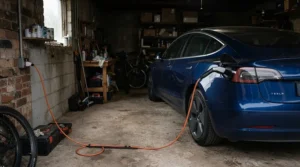
A 3-pin granny charger is easy to use, which is exactly why people get careless with it. Treat setup as a five-minute safety check, not a formality.
Before the first session:
- Inspect the wall socket. It should be firmly fixed, undamaged and free of scorch marks. Electrical Safety First advises having wiring checked before charging from a 13A socket, because old wiring may not cope with overnight demand.
- Plug straight into the wall. Never use a domestic multi-socket extension lead, and never daisy-chain leads.
- Choose a modest current. Start at 8A or 10A rather than 13A, especially on adjustable models.
- Manage the cable. Route it away from footpaths, and use a cable protector where needed to reduce trip risk.
During the first 30 days: check the plug top by hand after the first few sessions. Warm is normal; hot means stop and get the socket looked at. Replace the connector’s dust cap after each use and store the cable dry.
Common mistakes:
- Leaving 13A running all night.
- Using an unwound-reel extension.
- Ignoring the socket’s condition.
- Forgetting to check that the charger has a timer before relying on cheap-rate hours.
The lower settings on the EzGoGo 10m 3kW and Tera P03 are useful here, and the fixed 10A on the Ampwerk 10M and Masterplug EVCM221010-MP2 removes the temptation altogether.
Real-World Charging Scenarios: Matching a Portable EV Charger Cable to Your Life
Specs are abstract. Lives are not. Here are four profiles, each matched to a product with reasoning.
The flat-dweller with an allocated bay. Twenty-mile daily commute, a socket in a shared store, plugged in most nights. At 10A, the Masterplug EVCM221010-MP2 adds around 8 miles per hour, so a six-hour session comfortably covers a daily commute. The ten-metre reach helps with awkward bay positions, and fixed output suits a landlord-owned circuit you’d rather not push.
The rural driver with a long reach. A socket in an outbuilding and a 40-mile daily run. The EzGoGo 10m 3kW, in a longer variant if needed, gives you adjustable current, but limit yourself to sensible overnight settings. A 3-pin cable may be marginal for this mileage, so consider a wallbox.
The tariff hunter. Cheap electricity from midnight to 5am. The dé EV Charger 10m lets you schedule from your phone, provided Wi-Fi reaches the socket.
The traveller with a caravan or workshop. Access to commando sockets and occasional three-phase supply. The Juice Booster 2 justifies its premium here, since adapters unlock the speeds a 3-pin socket can’t.
Each profile differs in budget, environment and frequency of use, and the “best” product changes accordingly. That’s the point: there isn’t a single winner.
Problem → Solution: Fixing Common Portable EV Charger Cable Headaches
Problem: the charger pauses or faults mid-session. A warm or worn socket is the usual suspect. Drop to 8A or 6A, check the plug top for heat, and have an electrician inspect a socket that runs hot.
Problem: the cable doesn’t reach. Don’t join two charging cables together, as the connection can fail. Buy the right length from the start; ten metres suits most driveways, and the Tera P03 at six metres is best where the socket is close.
Problem: charging feels painfully slow. A 3-pin granny charger delivers roughly 2.3-3kW, which is about 8-10 miles per hour. That’s normal, so plan overnight sessions rather than quick stops.
Problem: the app disconnects. For the dé EV Charger 10m, check Wi-Fi strength at the socket, or use a mesh extender.
Problem: rain and grit in the connector. Replace dust caps after every use, and hang connectors off the ground with a holder like the one supplied with the Tera P03.
Most headaches trace back to socket condition, unrealistic expectations or cable length. Sort those three and the rest is detail.
What Is a Portable EV Charger Cable?
A portable EV charger cable is a lead with a domestic plug at one end, usually a UK 3-pin BS 1363, and a Type 2 connector at the other. A built-in control box manages safety and communication with your car. It lets you charge from an ordinary socket without installing a wallbox.
The control box is technically an in-cable control and protection device, or ICCB. It monitors temperature and load and shuts charging down if something goes wrong. Most cables are Mode 2, meaning the safety electronics sit in the cable itself. Type 2 fits every EV and plug-in hybrid sold since 2018, and some older or imported cars use Type 1, which needs a different cable or adapter.
You’ll see “10A” and “13A” versions. Ten amps at UK voltage gives roughly 2.3kW; thirteen gives about 3kW. The difference sounds small but has big consequences for how hot your plug gets, which is why most sensible guidance favours the lower figure for regular use.
How to Choose a Portable EV Charger Cable
- Confirm your connector. Check whether your car uses Type 2 or Type 1. Type 2 covers nearly everything modern.
- Measure the distance. Go from socket to charging port, allowing for how you park. Buy the shortest length that reaches comfortably.
- Pick your current. A fixed 10A is simplest; adjustable 6-13A gives flexibility. Prioritise adjustability if your wiring is uncertain.
- Check the weather rating. IP65-IP67 suits outdoor use. IP55 is fine under cover.
- Look for RCD protection. 30mA AC plus 6mA DC detection is the useful combination.
- Decide whether you need a timer or app. These matter if you’re chasing cheap-rate electricity.
- Verify certification. Look for UKCA or CE marking, and treat unmarked imports with suspicion.
Notice that “fastest” isn’t on the list. On a 3-pin socket, every model is capped by the socket, so speed claims deserve scepticism.
Portable EV Charger Cable vs Wallbox vs Public Charging
| Option | Typical Speed | Upfront Cost | Installation | Best For |
|---|---|---|---|---|
| Portable EV charger cable | 2.3-3kW | Low | None | Backup, travel, temporary use |
| 7kW home wallbox | Up to 7.4kW | Roughly £700-£1,200 installed | Electrician needed | Daily home charging |
| Public charging | Varies widely | Pay per session | None | Long journeys |
A dedicated 7kW wallbox charges about three times faster than a granny cable and adds smart features that can cut running costs. A portable EV charger cable wins on flexibility and cost, and it works at any house with a socket. Public charging wins when you need speed on the road.
The sensible strategy for many drivers is to combine them. Use a wallbox at home if you can, keep a portable EV charger cable as insurance, and use public rapid chargers for long trips. If you can’t install a wallbox yet, a 3-pin granny charger is a perfectly reasonable bridge.
Trickle Charging Explained: Getting the Best from Slow Charging
In EV circles, trickle charging means slow AC charging from a 3-pin socket at roughly 1.4-3kW. It’s not the same as a 12V battery trickle charger, which keeps a small auxiliary battery topped up. Here we’re talking about the main traction battery.
The car’s own on-board charger and battery management system control the process. The cable just supplies safe power and signals the car how much it may draw. Slow charging is generally considered gentle on batteries, though the real hazard sits at the socket, not the pack. Sustained high current warms the plug, so trickle charging at 8A or 10A is often a smarter habit than maxing out 13A.
As a general engineering point, very slow charging can be slightly less efficient because the car’s electronics draw a fixed overhead. Don’t fret about it, though. For low-mileage drivers, an overnight trickle charging session can replace a day’s driving, and for anyone else it’s a top-up rather than a lifestyle.
Some cables help you make the most of it. The delay timers on the Ampwerk 10M, EzGoGo 10m 3kW, Tera P03 and dé EV Charger 10m let you target off-peak hours rather than charging whenever you plug in.
Building a Backup Charging Solution That Actually Works
A good backup charging solution is boring. It lives in the boot, works first time and doesn’t need a manual.
Start with the network reality. Zapmap reports 121,171 public EV chargers across 46,731 UK locations by the end of June 2026. That is plenty, but chargers go offline, queues form and rural gaps remain. A portable EV charger cable lets any ordinary socket become a rescue point.
A three-part plan works well:
- Carry the cable. A 10m model such as the Masterplug EVCM221010-MP2 or Ampwerk 10M copes with most awkward sockets.
- Know the maths. One hour at 10A adds around 8 miles. Two to three hours can be enough to reach a rapid charger.
- Keep the accessories. A cable holder, spare dust caps and a bag prevent wet, dirty connectors.
Remember that a backup solution is for emergencies, not habit. If you rely on it daily, upgrade to a wallbox. The Juice Booster 2 stretches this idea, since adapters let one unit cover commando, camping and three-phase sockets.
Long-Term Cost and Maintenance
A portable EV charger cable is cheap to buy but not free to run. Consider an illustrative example. At a hypothetical 25p per kWh and 3.5 miles per kWh, a mile costs around 7p. On a hypothetical 8p off-peak rate, it’s closer to 2.3p. Those numbers are for illustration only; check your own tariff. The message is that a timer matters, because it lets a cheap cable capture cheap electricity.
Maintenance is minimal, but not zero:
- Wipe and cap connectors after each use.
- Inspect the cable and plug for damage.
- Store it dry, uncoiled loosely and away from sharp edges.
One UK supplier guide suggests a good cable should last three to five years with regular use. Treat that as a rough guide, not a guarantee, since quality varies.
If you rent or own a flat with private off-street parking, the government’s EV chargepoint grant offers 75% off the cost of buying and installing a socket, up to £500. Eligibility rules apply, including an OZEV-authorised installer, so check before ordering. That can make graduating from a 3-pin granny charger to a wallbox far more affordable than you’d expect.
Safety, Regulations and Compliance Guide
Safety is where cheap cables can go wrong, so it deserves a proper look.
Certification. Look for UKCA and CE marking. Relevant standards include IEC 61851-1 for Mode 2 charging, IEC 62752 for in-cable control devices and IEC 62196-2 for connectors. Uncertified imports may lack proper insulation or copper thickness.
Protection. Aim for residual-current protection covering 30mA AC and 6mA DC, plus over- and under-voltage and thermal protection. The dé EV Charger 10m and Masterplug EVCM221010-MP2 both list this combination.
The socket. A 13A socket isn’t designed for hours of continuous heavy load. Use an outdoor-rated socket with a weatherproof cover where possible, and never use a domestic multi-socket extension lead.
Second-hand and unbranded units. Electrical Safety First warns that second-hand EV chargers may be a serious fire risk and recommends buying only from reputable retailers. Register your product so you’re contactable in a safety recall.
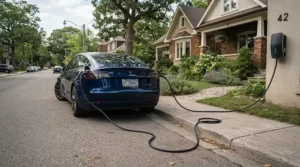
Cables across pavements. Trailing a lead over a public footpath creates a trip hazard, and local rules vary. Approved cross-pavement solutions exist for drivers with only on-street parking.
The rule of thumb is simple: buy certified, charge modestly, inspect regularly.
Frequently Asked Questions
❓ Can I leave a portable EV charger cable outside in the rain?
❓ How long does a 3-pin granny charger take to fully charge a 60kWh EV?
❓ Is trickle charging bad for an EV battery?
❓ Can a portable EV charger cable charge a Tesla in the UK?
❓ Can I run a portable EV charger cable across the pavement?
Conclusion
A portable EV charger cable won’t win any drag races, but it might save your evening. That’s why the right one matters more than the fastest one.
For most drivers, the Masterplug EVCM221010-MP2 is the balanced choice, combining ten metres of reach with solid protection and an independent editor’s-pick endorsement. If you like simplicity, the Ampwerk 10M keeps things fixed at 10A. The EzGoGo 10m 3kW and Tera P03 give you adjustable current, the Vorsprung 8m brings an independently tested pedigree, and the dé EV Charger 10m adds app scheduling. The Juice Booster 2 is the premium answer for travellers who’ll actually use its adapters.
Whichever you choose, treat it as a backup charging solution and a bridge to a proper wallbox rather than a daily crutch. Charge at modest currents, check the socket, and keep the cable dry. Prices vary, so check current pricing and availability before you buy.
Recommended for You
- Type 2 EV Charging Cable: 7 Best Picks for UK Drivers (2026)
- EV Charger for Octopus Intelligent Go: 7 Best Picks (2026)
- Tethered vs Untethered EV Charger: 7 Best UK Picks (2026)
Disclaimer: This article contains affiliate links. As an Amazon Associate, I earn from qualifying purchases. If you purchase products through these links, we may earn a small commission at no additional cost to you.
✨ Found this helpful? Share it with your friends! 💬🤗
