

In This Article
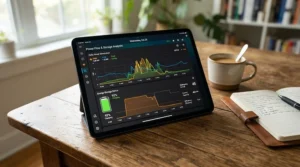
Here’s a scene most solar owners know too well: the sun’s been blazing all afternoon, your panels have clearly been working overtime, and yet your evening bill still stings. Without visibility into what your system is actually doing, you’re flying blind — and a solar battery monitoring add-on is the instrument panel you’ve been missing. In simple terms, a solar battery monitoring add-on is a small hardware device (usually a shunt, Hall sensor, or Bluetooth module) that clips onto your existing battery storage system and streams live voltage, current, state of charge, and history to an app on your phone. It doesn’t generate power or store it — it just tells you, honestly and continuously, what your battery is doing.

For UK households, this matters more than it might first appear. Our solar generation window is short and unpredictable, and most of us are out at work precisely when panels are producing the most. Getting a genuine read on your self-consumption rate — how much of your own solar power you actually use rather than exporting for pennies — is the difference between a system that quietly pays for itself and one that quietly underperforms for a decade. Add in the ability to track every charge/discharge cycle, and you’ve got the data you need to protect your battery’s lifespan and catch faults before they become expensive.
This guide walks through seven genuinely available monitoring add-ons for the UK market, from budget shunt displays to premium whole-system hubs, with honest analysis drawn from real specifications and aggregated review sentiment — not invented experience.
Quick Comparison Table
| Product | Type | Best For | Price Range |
|---|---|---|---|
| Victron SmartShunt 500A | Bluetooth shunt | Accuracy-focused DIY installers | £70-£110 |
| Renogy ONE Core (G3) | Whole-system hub | Multi-device Renogy setups | £120-£190 |
| Renogy Battery Shunt 300 | Shunt with display | Quick on-device checks | £65-£120 |
| Renogy BT-2 Bluetooth Module | Add-on Bluetooth module | Cheapest app upgrade for existing Renogy gear | £35-£45 |
| ANCEL BM1000 | Bluetooth smart shunt | Budget buyers wanting 30-day history | £80-£110 |
| ECO-WORTHY 300A Hall Sensor Monitor | Hall-effect monitor | No-cut, beginner-friendly installs | £35-£55 |
| eSynic 500A Battery Monitor | Basic shunt monitor | Absolute entry-level budgets | Under £30 |
Looking at the spread above, there’s a genuine gulf between the sub-£50 hall-sensor units and the app-connected shunts nearer £100 — and that gulf is mostly about data depth, not just build quality. Budget-conscious buyers monitoring a single leisure or garden battery will likely find the cheaper options perfectly adequate, while anyone running a proper home battery storage system alongside solar PV should lean toward the Bluetooth-enabled, history-logging options. Note that every price here is a range at the time of research; always check the current listing before buying, since retailer pricing shifts constantly.
💬 Just one click — help others make better buying decisions too!😊
Top 7 Solar Battery Monitoring Add-Ons: Expert Analysis
1. Victron SmartShunt 500A — gold-standard accuracy for serious systems
The standout here is precision: Victron’s shunt-based measurement is widely regarded as one of the most accurate coulomb-counting methods available to home users, and that accuracy compounds in value the longer you own the system. The Victron SmartShunt 500A measures current through a precision 50mV shunt and reports true state of charge, voltage, current, power, amp-hours consumed, and time-to-go, all relayed over Bluetooth to the free VictronConnect app — no display required, since your phone does that job. It also stores roughly 30 days of historical data, which is genuinely useful for spotting slow, creeping problems rather than just sudden ones.
Based on the spec comparison with cheaper alternatives, what most buyers overlook is that the SmartShunt’s low self-consumption (under a milliamp) means it won’t meaningfully drain your battery storage system even during long dormant periods — a real weakness in some rival products. It’s the pick for anyone who wants to eventually expand into a fuller Victron ecosystem, since it talks to GX devices and other Victron gear over VE.Direct. Reviewers consistently report smooth Bluetooth pairing and dependable long-term reliability, though a handful note that the companion app’s menus take some initial getting used to.
Pros:
- ✅ Widely regarded as one of the more accurate shunt-based monitors available
- ✅ Very low standby power draw protects battery reserve
- ✅ Expandable into the wider Victron GX device ecosystem
Cons:
- ❌ No onboard display — entirely dependent on your phone
- ❌ App learning curve for first-time users
At around £70-£110 depending on retailer and current, the Victron SmartShunt 500A earns its price through long-term reliability rather than flashy extras — solid value for anyone building a system meant to last a decade or more.
2. Renogy ONE Core (G3) — best for monitoring a whole multi-device setup
Where most add-ons watch a single battery, the Renogy ONE Core (G3) is built to be the command centre for an entire Renogy-based battery storage system — charge controllers, inverters, DC-DC chargers and batteries reporting into one dashboard. That’s the standout feature worth expanding on: it aggregates data from multiple RS485-connected devices simultaneously, rather than forcing you to flick between separate apps for each component.
The unit logs historical performance, generates usage reports, and can send alerts for abnormal voltage or temperature events through the Renogy DC Home app. On paper this means fewer blind spots across a system with several moving parts — genuinely valuable once you’ve got more than a battery and a single charge controller to keep an eye on. What most buyers overlook is that this kind of centralised logging is exactly what you need to calculate a meaningful self-consumption rate over weeks rather than guessing from a single day’s snapshot. Aggregated user feedback suggests the setup process is more involved than a simple Bluetooth pairing, reflecting its role as a hub rather than a plug-and-play gadget, and a few users mention occasional firmware update hiccups.
Pros:
- ✅ Aggregates data from multiple Renogy devices in one dashboard
- ✅ Generates historical usage reports and abnormal-event alerts
- ✅ Scales well as your battery storage system grows
Cons:
- ❌ More complex initial setup than single-device monitors
- ❌ Best value only if you already own compatible Renogy gear
Priced in the region of £120-£190, the Renogy ONE Core (G3) suits buyers with (or planning) a multi-component system rather than someone monitoring one lone battery.
3. Renogy Battery Shunt 300 — clearest onboard display for quick checks
Not everyone wants to unlock a phone to check their battery — sometimes you just want a glance. The Renogy Battery Shunt 300 answers that with a built-in display showing voltage, current, and remaining capacity directly on the unit, alongside high and low voltage programmable alarms.
The shunt-based current sensing here means accuracy stays close to premium units at a friendlier price point, and the 20ft shielded cable gives installers flexibility on where they mount the display versus the shunt itself. Here’s what to weigh: without native Bluetooth, this unit is closer to a “set it and glance at it” tool than a data-logging platform, so anyone hoping to chart a precise self-consumption rate over time will need to note readings manually or pair it with a separate logging solution. Reviewers consistently note the display’s brightness and legibility as strong points, even in daylight garages or outbuildings, while a recurring complaint concerns the somewhat fiddly initial calibration against actual battery capacity.
Pros:
- ✅ Built-in display means no app required for basic checks
- ✅ High/low voltage programmable alarms included
- ✅ Long shielded cable gives flexible mounting options
Cons:
- ❌ No native Bluetooth or historical data logging
- ❌ Initial capacity calibration can be fiddly
Sitting around £65-£120, the Renogy Battery Shunt 300 is best value for buyers who prioritise a physical readout over smartphone connectivity.
4. Renogy BT-2 Bluetooth Module — cheapest way to add app monitoring to existing Renogy gear
If you already own a compatible Renogy charge controller, DC-DC charger, or smart lithium battery but skipped the Bluetooth version, the Renogy BT-2 Bluetooth Module is the retrofit fix. It plugs into the RJ45 communication port on supported devices and wirelessly relays real-time and historical data to the Renogy DC Home app over Bluetooth 4.2/BLE.
The practical upside is cost: rather than replacing existing hardware to gain smartphone monitoring, you’re adding a small module for a fraction of the price. What the spec sheet won’t tell you, but user reports suggest, is that range can be more variable indoors than the stated distance implies, particularly through brick walls or metal enclosures common in UK garages and sheds. It’s strictly an add-on rather than a standalone monitor — it needs a compatible RS485-equipped host device to function at all, so check compatibility carefully before buying. For the right existing setup, though, it’s an efficient, low-cost route to full app-based tracking of your battery storage system’s day-to-day behaviour.
Pros:
- ✅ Cheapest way to add Bluetooth monitoring to existing Renogy kit
- ✅ Provides real-time and historical data via a free app
- ✅ Quick installation with no rewiring of the host device
Cons:
- ❌ Only works with compatible RS485-equipped Renogy products
- ❌ Real-world Bluetooth range can fall short indoors
At roughly £35-£45, the Renogy BT-2 Bluetooth Module delivers strong value purely as an upgrade path — but only if your existing hardware supports it.
5. ANCEL BM1000 — best 30-day history on a budget
The ANCEL BM1000 targets a specific pain point: many budget monitors either lack history entirely or expect you to buy an oversized, overpriced shunt for headroom you’ll never use. Its standout feature is deliberately sizing the shunt at 400A — matched to typical RV, marine, and solar peak loads of 100-300A — while still delivering 30 days of scrollable voltage, current, and temperature history through its app.
Factory calibration across multiple points targets roughly ±1% accuracy, which, based on the spec comparison with entry-level rivals, is a meaningfully tighter tolerance than many similarly priced hall-sensor units claim. The 0.5W standby draw is honest rather than class-leading, but it’s low enough not to meaningfully dent a battery storage system left dormant over a UK winter. Aggregated review sentiment describes the wide 10-120V range and reverse-polarity protection as reassuring for first-time installers, though some users note the companion app, while functional, feels less polished than more established brands’ offerings.
Pros:
- ✅ 30 days of scrollable historical data via the app
- ✅ Factory-calibrated for roughly ±1% accuracy
- ✅ Wide 10-120V compatibility with built-in overload protection
Cons:
- ❌ App interface feels less refined than premium competitors
- ❌ Newer brand with a shorter UK track record
Around £80-£110, the ANCEL BM1000 is a smart pick for buyers who want genuine data history without paying premium-brand prices.

6. ECO-WORTHY 300A Battery Monitor with Hall Sensor — no-cut installation for nervous DIYers
Shunt-based monitors require breaking the negative (or positive) cable and wiring the shunt inline — fiddly for anyone unfamiliar with electrical work. The ECO-WORTHY 300A Battery Monitor sidesteps that entirely using Hall-effect sensing, which clips around the existing cable to read current without cutting anything.
That single design choice is the whole story here: it lowers the installation barrier considerably, which is exactly why this model turns up so often in first-time solar and leisure-battery setups. The touchable backlit display shows real-time voltage, current, and status, with programmable high/low alarms for peace of mind. Here’s what to weigh: Hall-effect sensing typically trades a little precision for that installation convenience, so buyers chasing laboratory-grade accuracy for a large battery storage system should look toward shunt-based options instead. Reviewers consistently flag the straightforward setup as the headline benefit, while a recurring theme in feedback is that initial parameter configuration (capacity, cut-off voltage) needs to be done carefully to avoid skewed readings later.
Pros:
- ✅ Hall-sensor design needs no cable cutting to install
- ✅ Touchable backlit display with programmable alarms
- ✅ Compatible with a wide 9-80V range of battery chemistries
Cons:
- ❌ Slightly less precise than shunt-based measurement
- ❌ Accuracy depends heavily on correct initial setup
Priced around £35-£55, the ECO-WORTHY 300A Battery Monitor is excellent value for anyone who wants monitoring without the installation faff.
7. eSynic 500A Battery Monitor with Shunt — lowest entry price for basic tracking
Sometimes you genuinely just need the basics, and the eSynic 500A Battery Monitor covers them without ceremony: voltage, current, and capacity readings on a simple onboard screen, wired via an included shunt.
The standout advantage is price — this sits at the very bottom of the market, making it a sensible starting point for a single leisure battery, small off-grid setup, or garden battery storage system where budget matters more than data depth. On paper this means you’re trading away smartphone connectivity, historical logging, and refined accuracy calibration in exchange for a genuinely low upfront cost. What the spec sheet won’t tell you, but user reports suggest, is that build quality at this price point can be inconsistent between batches, so it pays to check current reviews before ordering. It’s not the monitor for tracking a precise self-consumption rate over months, but for simply confirming your battery isn’t dangerously low or overcharging, it does the essential job.
Pros:
- ✅ Lowest price point in this comparison
- ✅ Simple onboard display needs no app or pairing
- ✅ Includes shunt and wiring for straightforward installation
Cons:
- ❌ No Bluetooth, app, or historical data logging
- ❌ Build consistency reportedly varies between batches
At under £30, the eSynic 500A Battery Monitor is the pick for absolute budget-first buyers who want basic reassurance rather than deep analytics.
| Product | Measurement Type | Connectivity | History Logging | Best For |
|---|---|---|---|---|
| Victron SmartShunt 500A | Shunt (50mV) | Bluetooth | ~30 days | Accuracy-first installers |
| Renogy ONE Core (G3) | Multi-device hub | Bluetooth/RS485 | Extended reports | Multi-device systems |
| Renogy Battery Shunt 300 | Shunt | Wired display | None (manual) | On-device quick checks |
| Renogy BT-2 Bluetooth Module | N/A (add-on) | Bluetooth 4.2/BLE | Via host app | Existing Renogy owners |
| ANCEL BM1000 | Shunt (400A) | Bluetooth | 30 days | Budget history tracking |
| ECO-WORTHY 300A Hall Sensor | Hall-effect | Onboard display | None (manual) | No-cut installs |
| eSynic 500A Shunt Monitor | Shunt | Onboard display | None | Absolute entry-level |
This second table strips the comparison down to the mechanics that actually affect day-to-day use: how each unit measures current, how you access the data, and whether it remembers anything. The clearest pattern is that Bluetooth connectivity and history logging travel together — if you want to genuinely analyse your self-consumption rate over weeks, you need one of the app-connected options, not a wired display alone. Hall-sensor units like the ECO-WORTHY 300A Hall Sensor trade a touch of precision for painless installation, which is a fair trade for casual users but a real consideration for anyone running a demanding battery storage system.
Practical Usage Guide: Setting Up Your Solar Battery Monitoring Add-On
Getting a solar battery monitoring add-on installed correctly in the first 30 days sets the tone for years of accurate data, so it’s worth doing properly rather than rushing it. Start by confirming your battery chemistry and nominal capacity — LiFePO4, AGM, and lead-acid batteries behave differently, and most monitors need this entered manually during setup. For shunt-based units like the Victron SmartShunt 500A or eSynic 500A Battery Monitor, always connect the shunt to the negative terminal unless the manual specifically says otherwise, since getting this backwards is the single most common installation mistake reported across forums.
Once wired, run a full charge-to-discharge cycle before trusting the numbers. This “synchronises” the monitor’s internal state-of-charge calculation with reality — skip it, and your first few weeks of readings will drift. 🔋 A common early mistake is checking the app once, seeing an odd number, and assuming the device is faulty, when in fact it simply hasn’t completed its first calibration cycle yet.
For maintenance, periodically re-sync after several months, especially if you notice the reported state of charge diverging from expected behaviour — batteries age, and their real capacity shrinks over years even if the monitor’s settings don’t update automatically. Keep firmware current where the manufacturer offers updates through the app; this is a common optimisation trick that Amazon listings rarely mention, since it often resolves Bluetooth stability issues that show up in aggregated review sentiment for several of these products.
✨ Don’t Miss These Exclusive Deals!
🔍 Take your battery storage system to the next level with these carefully selected monitoring add-ons. Click on any highlighted item to check current pricing and availability.
Real-World Scenarios: Which Solar Battery Monitoring Add-On Fits You?
The weekend off-grid cabin owner: If you’re topping up a single leisure battery a couple of times a month and mostly want reassurance you won’t come back to a flat system, the eSynic 500A Battery Monitor or ECO-WORTHY 300A Battery Monitor with Hall Sensor covers it without overspending on features you’ll rarely open an app to check.
The family home with solar PV and a battery storage system: Here, self-consumption rate is the whole game — every percentage point you shift from grid-import to battery-discharge saves real money at UK electricity prices. The Victron SmartShunt 500A or ANCEL BM1000 give the historical data needed to actually track that improvement over seasons, not just guess at it.
The multi-component off-grid or motorhome system: Once you’ve got a charge controller, inverter, DC-DC charger, and battery all working together, checking four separate apps gets old fast. The Renogy ONE Core (G3) consolidates everything into one dashboard, which based on the spec comparison against single-device monitors, saves genuine time and reduces the chance of missing a fault buried in one component’s isolated data.
The existing Renogy owner upgrading incrementally: If you already own compatible charge controllers or batteries but skipped the Bluetooth variant, the Renogy BT-2 Bluetooth Module is the obvious low-cost bridge to app-based monitoring without replacing hardware that already works fine.
Problem → Solution: Fixing Common Battery Storage Monitoring Issues
Problem: readings drift from reality over time. This almost always traces back to a missed full charge/discharge cycle during setup, or a battery that’s genuinely aged past its rated capacity. Solution: run a fresh full cycle and, on units like the Victron SmartShunt 500A, manually update the battery capacity setting to reflect real-world ageing.
Problem: Bluetooth keeps dropping. Common on budget units placed inside metal enclosures or behind thick walls. Solution: reposition the shunt or module closer to an opening, or consider a wired-display option like the Renogy Battery Shunt 300 if your installation location is particularly shielded.
Problem: can’t tell whether your self-consumption rate is actually improving. Without historical logging, you’re comparing memory against memory. Solution: switch to a monitor with data history, such as the ANCEL BM1000, and start exporting or screenshotting weekly summaries to build your own comparison over months.
Problem: alarms triggering constantly for no clear reason. Usually a symptom of thresholds set too conservatively during a rushed setup. Solution: revisit the programmable alarm settings on units like the ECO-WORTHY 300A Battery Monitor with Hall Sensor and widen the voltage bands slightly, then narrow them once you understand your system’s normal operating range.
How to Choose a Solar Battery Monitoring Add-On
Choosing the right solar battery monitoring add-on comes down to matching device capability to how seriously you want to track your battery storage system. Here’s the reasoning behind the criteria that actually matter:
- Measurement method. Shunt-based units generally edge out Hall-effect sensors on precision, but Hall sensors avoid the need to cut cables — decide how much accuracy you genuinely need versus how much installation hassle you’ll tolerate.
- Connectivity. Bluetooth and app access unlock historical trends; wired displays are simpler but leave you manually tracking change over time.
- History depth. If tracking self-consumption rate or long-term charge/discharge cycle tracking matters to you, prioritise units offering 30 days or more of stored data.
- Compatible voltage and current range. Check your battery bank’s actual voltage and expected peak current against the monitor’s rated range — oversizing wastes accuracy, undersizing risks damage.
- Ecosystem compatibility. If you already own charge controllers or inverters from a specific brand, an add-on module (like the Renogy BT-2 Bluetooth Module) is often cheaper than a standalone unit.
- Alarm and alert flexibility. Programmable high/low voltage alarms are worth prioritising if the battery protects anything safety-critical, like backup power for medical equipment.
- Installation complexity. Be honest about your comfort with basic electrical work before committing to a shunt-based install over a clip-on Hall sensor.
Common Mistakes When Buying a Solar Battery Monitoring Add-On
The most frequent mistake is buying based on maximum current rating alone, assuming bigger is automatically better. In practice, an oversized shunt monitoring a modest battery storage system can actually deliver less precise low-current readings than a correctly matched unit — the ANCEL BM1000‘s deliberately modest 400A rating exists specifically to counter this tendency.
A second common error is skipping compatibility checks on add-on modules. The Renogy BT-2 Bluetooth Module, for instance, only works with RS485-equipped host devices, and buyers occasionally purchase it expecting standalone functionality it was never designed to provide. Third, many buyers underestimate how much the first full charge/discharge cycle matters for calibration accuracy, then judge a perfectly good device as faulty based on unsynchronised early readings. Finally, ignoring UK-specific installation and safety considerations — covered later in this guide — is a mistake that can affect both warranty validity and genuine electrical safety.
Solar Battery Monitoring Add-On vs Built-In App Monitoring
Many modern home battery storage systems, particularly branded all-in-one units, come with built-in app monitoring from the manufacturer. So why add a separate solar battery monitoring add-on at all?
| Factor | Dedicated Add-On | Built-In App Monitoring |
|---|---|---|
| Data granularity | Often more detailed (raw voltage/current) | Usually simplified, brand-specific metrics |
| Cross-brand compatibility | Works across mixed-brand systems | Locked to one manufacturer’s ecosystem |
| Historical export | Frequently supports raw data export | Rarely, unless brand offers it |
| Best For | DIY, off-grid, and mixed-component setups | Single-brand, all-in-one home batteries |
The written comparison matters more than the table alone: built-in monitoring from major home battery brands is often perfectly adequate for everyday use, since it’s purpose-built for that exact hardware and tends to be more polished visually. However, a dedicated add-on like the Victron SmartShunt 500A genuinely wins for anyone with a mixed-brand battery storage system, where no single manufacturer’s app can see the whole picture. It also tends to offer more granular, exportable data — useful if you’re serious about tracking self-consumption rate trends over multiple seasons rather than glancing at a simplified dashboard.

Understanding Your Self-Consumption Rate (And Why Monitoring Boosts It)
Your self-consumption rate is simply the percentage of solar electricity you generate that you actually use yourself, rather than exporting to the grid. According to guidance from Which?, pairing solar panels with battery storage lets households make far greater use of the electricity they generate rather than sending it to the National Grid for a comparatively small return.
Here’s why this matters financially: most UK households generate the bulk of their solar power between roughly 10am and 4pm, precisely when many people are out at work or school. Without a battery — and without the visibility a monitoring add-on provides — that surplus simply exports for a modest per-unit rate under schemes like the Smart Export Guarantee, while the same household buys back grid electricity in the evening at a considerably higher price. A solar battery monitoring add-on doesn’t change the underlying economics, but it makes them visible: watching your self-consumption rate climb from, say, 35% to 65% after adjusting habits or battery sizing is a genuinely motivating feedback loop that a vague sense of “the panels are working” simply can’t provide.
Practically, improving your self-consumption rate often means shifting flexible loads — washing machines, dishwashers, EV charging — into daylight hours once your monitor shows a consistent generation pattern. Reviewers of app-connected monitors like the ANCEL BM1000 and Victron SmartShunt 500A frequently mention this exact use case: using historical charts to identify when surplus solar is being wasted, then adjusting routines accordingly.
Charge/Discharge Cycle Tracking: Why It Protects Your Battery Investment
Every time a battery is drawn down and recharged, that counts as one charge/discharge cycle, and most battery chemistries have a rated cycle life after which usable capacity noticeably declines. Lead-acid and AGM batteries typically tolerate far fewer cycles than modern LiFePO4 cells, which is exactly why charge/discharge cycle tracking matters so much for protecting a meaningful financial investment.
A solar battery monitoring add-on with historical logging — such as the Victron SmartShunt 500A or Renogy ONE Core (G3) — records not just how many cycles a battery has completed, but how deep each discharge went. What most buyers overlook is that shallow, frequent cycles are generally gentler on a battery than deep, infrequent ones, so two batteries with an identical cycle count can be in very different states of health depending on discharge depth history. Tracking this over time lets you spot a battery that’s ageing faster than expected, well before it fails outright and leaves your battery storage system underperforming during exactly the evening peak you bought it for.
For anyone whose warranty terms are tied to cycle count or depth-of-discharge limits — common across most reputable UK-sold home batteries — this data isn’t just interesting, it’s evidence. Keeping your own charge/discharge cycle tracking records, independent of the battery manufacturer’s own reporting, gives you a second reference point if you ever need to make a warranty claim.
Long-Term Cost & Maintenance
A solar battery monitoring add-on is a small upfront cost relative to the battery storage system it’s protecting, but the long-term value case is worth spelling out. Total cost of ownership includes not just the purchase price but any app subscription (rare in this category, but worth checking), replacement cost if a unit fails, and — most importantly — the value of the problems it helps you avoid.
| Consideration | Budget Add-On (e.g. eSynic) | Premium Add-On (e.g. Victron) |
|---|---|---|
| Upfront cost | Under £30 | £70-£110 |
| Data history | None | ~30 days |
| Early fault detection | Manual, less reliable | Automated alerts |
| Long-term value | Adequate for simple systems | Stronger ROI on larger, complex systems |
The analysis here is straightforward: a budget monitor genuinely suits a modest, low-stakes battery, but as your battery storage system grows in size and cost, the case for a monitor capable of catching a slow fault — a failing cell, a creeping imbalance, a cycle count exceeding warranty terms — strengthens considerably. Maintenance itself is minimal across this category; periodic firmware updates and an occasional recalibration cycle are typically all that’s required, making the ongoing cost of ownership negligible compared with the battery it’s watching over.
Safety & Regulations Guide for UK Battery Storage Monitoring
UK battery storage installations sit within a fairly clear regulatory framework, and it’s worth understanding where a monitoring add-on fits. According to guidance published by Highland Council, battery storage systems paired with solar PV should be installed following recognised standards, with attention paid to safe wiring and appropriate certification of the overall system.
Most solar battery monitoring add-ons themselves are low-voltage DC accessories and, being aftermarket devices, should carry UKCA or CE marking confirming they meet UK and EU safety standards — always check the product listing or manual for this before purchase. That said, the monitor doesn’t replace the need for a properly certified installation of the battery and inverter themselves; if your system is eligible for the Smart Export Guarantee, an MCS-certified installation is typically required regardless of what monitoring hardware you add afterwards.
Practically, this means: install shunts and Hall sensors according to the manufacturer’s wiring diagram, never bypass a battery management system’s safety cut-offs to “improve” a reading, and if you’re not confident working with battery cabling, have a qualified installer fit the add-on during routine servicing rather than doing it yourself. None of the seven products covered here require rewiring your consumer unit, but they do involve working directly at the battery terminals, so basic care and, ideally, gloves and eye protection are sensible precautions.

Frequently Asked Questions
❓ Does a solar battery monitoring add-on work with any battery storage system?
❓ How accurate is a solar battery monitoring add-on?
❓ Can I track my self-consumption rate without a battery?
❓ Do I need an electrician to install a solar battery monitoring add-on?
❓ How long does charge/discharge cycle data stay accurate?
Conclusion
A solar battery monitoring add-on isn’t the flashiest purchase in your renewable energy setup, but it’s arguably one of the most quietly valuable. Whether you land on the accuracy-focused Victron SmartShunt 500A, the multi-device convenience of the Renogy ONE Core (G3), or a budget-friendly option like the ECO-WORTHY 300A Battery Monitor with Hall Sensor, the underlying value is the same: real visibility into what your battery storage system is actually doing, day and night.
Getting a genuine read on your self-consumption rate turns solar ownership from a hopeful assumption into a measurable, improvable habit, while consistent charge/discharge cycle tracking protects the battery investment itself against premature ageing and warranty disputes. None of these seven products will generate a single extra watt of solar power on their own — but they’ll make sure you’re actually capturing the value of the watts you’re already generating, which, for most UK households, is where the real savings are hiding.
Recommended for You
- Energy Monitor for Time of Use Tariffs: 7 Best UK Picks (2026)
- Energy Monitor for Octopus Agile: 7 Best Picks (2026)
- Whole Home Energy Monitor Clamp: 7 Best UK Picks (2026)
Disclaimer: This article contains affiliate links. As an Amazon Associate, I earn from qualifying purchases. If you purchase products through these links, we may earn a small commission at no additional cost to you.
✨ Found this helpful? Share it with your friends! 💬🤗
