
In This Article
A smart relay module for garage door control is a small Wi-Fi or Zigbee switch that wires into your opener’s push-button terminals and imitates a wall-button press. It uses a dry contact relay, so it sends no power into the opener, letting you open, close and monitor the door from your phone.

Here’s the thing about garage openers: they are built like tanks and wired like it’s 1998. A decade-old Hörmann or Novoferm will happily lift a door every morning for years, yet it has no idea what a smartphone is. Replacing it can run to several hundred pounds. A relay module costs about the same as a takeaway for two.
The trick is the “dry contact”, also called a volt-free or potential-free contact. Wikipedia’s entry on dry contacts explains it neatly: the contact is not “wetted” by a voltage source, so it behaves like a clean button press rather than a power feed. That is exactly what your opener’s control terminals expect.
In this guide I compare seven real options for garage door automation, from tiny Wi-Fi relays to a plug-and-play kit built for remote garage access. Along the way you’ll get setup advice, UK safety context, and honest analysis grounded in published specifications and aggregated owner feedback. No fluff, no invented testing.
Quick Comparison: Smart Relay Module for Garage Door Options at a Glance
Before the deep dive, here is the whole field on one screen.
| Product | Type | Connectivity | Contact rating | Best For |
|---|---|---|---|---|
| Shelly 1 Gen3 | Bare relay module | Wi-Fi + Bluetooth | 16A | Best all-rounder for tinkerers |
| Shelly 1 Mini Gen3 | Ultra-compact relay | Wi-Fi + Matter | 8A | Hiding inside the opener housing |
| Sonoff MINI-D | Dry contact relay | Wi-Fi (Matter-enabled) | 2A | Cheapest signal-only trigger |
| Aqara Dual Relay Module T2 | Dual relay | Zigbee 3.0 (hub needed) | 10A | Double garages and Aqara homes |
| Meross MSG100HK | Complete kit with sensor | Wi-Fi (HomeKit) | Not published | Plug-and-play with door status |
| Shelly Plus 1 | Bare relay module | Wi-Fi + Bluetooth | 16A | Scripting fans, previous generation |
| Sonoff SV | Low-voltage relay board | Wi-Fi (ESP-based) | Not published | DIY and Tasmota hobbyists |
Looking at the table, the Shelly 1 Gen3 and Sonoff MINI-D cover most households at the lowest cost, while the Meross MSG100HK is the only one that arrives with a door sensor included. If you own two doors, the Aqara Dual Relay Module T2 is the natural fit because one unit has two relays. Budget buyers should note that the Sonoff SV is a hobbyist board rather than a polished product.
💬 Just one click — help others make better buying decisions too!😊
Top 7 Smart Relay Module for Garage Door Picks: Expert Analysis
Each pick below is judged on published specs and aggregated owner sentiment. Prices are ranges only, so check current price before buying.
1. Shelly 1 Gen3 — best all-round dry contact pick
The Shelly 1 Gen3 wins by doing the unglamorous job properly: a genuinely isolated relay in a box small enough to hide behind a wall plate.
Its output is independent of its own power supply, which is the whole point of a dry contact relay. You can power the module from 110-240V AC, 12V DC or 24-48V DC while the contacts simply close like a button. In practice, that means you can feed it from a spare low-voltage supply near the opener and never put mains onto the opener’s control circuit. Wi-Fi plus Bluetooth keeps setup painless, and simultaneous cloud and MQTT support suits anyone running Home Assistant.
Based on the spec comparison, this is where I’d point most UK households first. The 16A rating is overkill for a push-button circuit, but it means the same unit could later switch a garage light without a rethink. The catch is that it’s a bare module, not a kit, so you need basic wiring confidence.
I couldn’t find a meaningful pool of independent reviews for this exact Gen3 model at the time of research, so I won’t pretend otherwise. Owners of its predecessor, built on the same relay concept, consistently describe it as easy to wire and dependable on Wi-Fi.
Pros:
- ✅ Truly isolated dry contact output
- ✅ Flexible 110-240V AC or low-voltage DC power
- ✅ Cloud and MQTT work simultaneously
Cons:
- ❌ Bare module needs sensible wiring skills
- ❌ No door sensor included for status
Expect to pay around £10-£15 (check current price). For the money, it’s the benchmark the others have to beat.
2. Shelly 1 Mini Gen3 — smallest relay that fits inside the opener
The Shelly 1 Mini Gen3 is for people who open the opener’s casing and think, “there’s room in here.”
The retailer listing calls it the smallest Wi-Fi relay in the range, with a single 8A channel, and says it can be installed directly in the opener body or near the motor. That matters because a module tucked inside the housing keeps wiring short, tidy and out of reach of curious children. It also lists Matter, local control and Home Assistant support, which future-proofs it for newer ecosystems.
My take: 8A is plenty because a garage opener’s button circuit draws a trickle. What you gain over the bigger Shelly 1 Gen3 is placement flexibility, and what you give up is headroom for switching bigger loads. If your opener has a roomy ceiling-mounted head unit, this is the neater solution.
On reviews, I couldn’t verify a robust set of independent ratings for this newer model, so treat any claim of “thousands of happy owners” with suspicion. What the listing does show is a manufacturer pitching it specifically at garage-door duty.
Pros:
- ✅ Tiny enough to fit inside most openers
- ✅ Matter and local control support listed
- ✅ Works with Alexa and Home Assistant
Cons:
- ❌ 8A ceiling limits other uses
- ❌ Check which power-supply range your version supports
Look for roughly £10-£15 (prices may vary). Great value if space is your main constraint.
3. Sonoff MINI-D — cheapest Matter-ready dry contact trigger
The Sonoff MINI-D is the budget answer to a simple question: what is the least I can pay for a clean button-press over Wi-Fi?
It offers dry contact output with both normally open and normally closed configurations, and the manufacturer pitches it at garage door openers, boilers and access panels. The relay is rated at 2A, which is entirely adequate for signalling an opener but rules out switching anything hefty. It’s also described as Matter-enabled, so it can play nicely with Apple Home, Google Home and Alexa without a hub.
Here’s what most buyers overlook: a low current rating isn’t a flaw for this job, it’s a sign the product knows its place. The risk is buying it for a second purpose, like a heater, and discovering the limit the hard way. Keep it on signal duty and it’s a tidy piece of kit.
An independent comparison site drawing on Amazon data scores it a touch higher than the Shelly Plus 1 for owner reception (4.7 versus 4.6 stars), and favours it for gate and garage jobs on price. Treat that as a directional signal rather than gospel.
Pros:
- ✅ NO and NC dry contact output
- ✅ Matter-enabled for hub-free pairing
- ✅ Very low cost of entry
Cons:
- ❌ 2A rating means signal duty only
- ❌ Verify the supply voltage range before wiring
Budget around £10-£15 (check current price). Superb value if you stay in its lane.
4. Aqara Dual Relay Module T2 — best for double doors and Zigbee homes
The Aqara Dual Relay Module T2 is the only pick here with two relays, which makes it a natural fit for a double garage.
It runs on Zigbee 3.0 and requires an Aqara hub, sold separately. In dry contact mode you can choose a pulse signal or an on-off signal, and you switch from wet to dry by disconnecting a red jumper wire. It also accepts one or two binary sensors, so a magnetic reed switch can report whether the door is open. Matter and HomeKit support arrive through the hub, and the module remembers its state after a power cut.
On paper, the pulse-versus-latching choice is the clever bit: pulse mimics a button, while on-off suits openers with separate open and close inputs. The trade-off is the hub, which turns a cheap tinker into a small ecosystem decision. If you already own an Aqara hub, it’s a bargain, and if not, factor that cost in.
Owner feedback I could verify is thin. One retailer-listing user simply reports it works as it should for garage door automation, which is reassuring but anecdotal.
Pros:
- ✅ Two relays for two doors
- ✅ Pulse and latching dry contact modes
- ✅ Sensor inputs enable door-state automations
Cons:
- ❌ Aqara hub required, sold separately
- ❌ Mains-powered, so wiring needs care
Roughly £30-£40 for the module alone (prices may vary). Good value once you count the second relay.
5. Meross MSG100HK — plug-and-play kit with a door sensor
The Meross MSG100HK is the one I’d hand to a non-DIY friend, because it ships as a kit rather than a component.
The box includes a USB power adapter, door sensors on a 7-metre (23ft) wire, a test wire and fixings. It supports Apple HomeKit, Alexa, Google Assistant and SmartThings, with alerts for open, closed and left-open-too-long. Meross says there’s no subscription. The sensor wire is the smart part: a wired magnetic sensor needs no battery and tells you whether the door is actually shut.
This is the pick where analysis matters most. Meross’s own guidance says the two sensor halves must sit within an inch of each other when the door is closed, and a quick test is to short the wall-button terminals to see if the door moves. That’s reassuringly practical, but it also hints where problems arise: sensor alignment.
An independent review summary praises native HomeKit control, the wired sensor and no subscription, but marks it down for thin installation instructions. That squares with my reading.
Pros:
- ✅ Door sensor and test wire included
- ✅ Native HomeKit plus Alexa and Google
- ✅ No subscription fee claimed
Cons:
- ❌ Installation instructions reportedly thin
- ❌ Needs a USB power socket nearby
Think around £25-£40 (check current price). The best value if you want remote garage access without soldering anything.
6. Shelly Plus 1 — scripting powerhouse from the previous generation
The Shelly Plus 1 is the proven workhorse that the Gen3 now supersedes, and it still has a loyal following.
It offers a 16A relay (the distributor lists 240V AC and 30V DC switching limits), Wi-Fi and Bluetooth, and a built-in processor that runs scripts and schedules. The dry contact input can monitor a contact closure, which means a door sensor can be read by the same unit that triggers the opener. Integration spans MQTT, Home Assistant, SmartThings, Hubitat and openHAB, plus Alexa and Google voice assistants.
My analysis: scripting is the underrated feature. You could, for instance, program the relay to close the door automatically after a set time, then test that behaviour carefully. The downside is availability, since one European distributor lists it as no longer available from the manufacturer. That makes the Shelly 1 Gen3 the safer buy unless you find a good deal.
One retailer reviewer called it brilliant, praised how easily it wires up, and said remote operation felt better than eWeLink, Sonoff or Tuya. That is a single opinion, but it matches broader enthusiast chatter.
Pros:
- ✅ Scripting and sunrise-sunset scheduling built in
- ✅ Switch input can sense door contact
- ✅ Broad smart-home platform support
Cons:
- ❌ Being superseded, so stock is patchy
- ❌ Bare module, no enclosure or sensor
Expect roughly £12-£20 where stocked (prices may vary). Still good value if you can find one.
7. Sonoff SV — the tinkerer’s low-voltage relay board
The Sonoff SV is not a polished consumer product, and that’s precisely why makers love it.
The “Safe Voltage” board can run from 5-24V DC, which suits a low-voltage supply near the opener, and it exposes extra GPIO pins for sensors. Enthusiast documentation notes that mains operation requires desoldering parts and carries warnings, so I’d treat this as DC only. With open firmware such as Tasmota, you can add a reed sensor and build a fully local controller.
Based on the spec comparison, this is the cheapest way to learn how a smart relay module for garage door duty actually works. The compromise is effort: you flash firmware, find a template and verify everything with a multimeter. One DIY blogger lists it as a handy alternative alongside Shelly and Z-Wave options.
I couldn’t verify meaningful mainstream customer ratings, so treat this strictly as an enthusiast recommendation. If you’ve never touched a soldering iron, pick a kit instead.
Pros:
- ✅ Runs on 5-24V DC supply
- ✅ Extra GPIO pins for sensors
- ✅ Very cheap and hackable
Cons:
- ❌ Requires flashing and DIY skills
- ❌ Not a finished, supported consumer product
Typically under £10 (check current price and availability). Superb value for hobbyists, poor value for everyone else.
Top 7 Comparison: Specs, Price Ranges and Review Picture
| Product | Contact rating | Connectivity | Price range | Review picture | Best For |
|---|---|---|---|---|---|
| Shelly 1 Gen3 | 16A | Wi-Fi, Bluetooth | £10-£15 | Limited for Gen3 | Shelly 1 Gen3 for all-round value |
| Shelly 1 Mini Gen3 | 8A | Wi-Fi, Matter | £10-£15 | Limited for Mini | Shelly 1 Mini Gen3 for tight spaces |
| Sonoff MINI-D | 2A | Wi-Fi, Matter | £10-£15 | Positive on aggregators | Sonoff MINI-D for budget signal duty |
| Aqara Dual Relay Module T2 | 10A | Zigbee 3.0 | £30-£40 | Thin but positive | Aqara Dual Relay Module T2 for two doors |
| Meross MSG100HK | Not published | Wi-Fi | £25-£40 | Good, weak manual | Meross MSG100HK for beginners |
| Shelly Plus 1 | 16A | Wi-Fi, Bluetooth | £12-£20 | Positive, older | Shelly Plus 1 for scripting |
| Sonoff SV | Not published | Wi-Fi (ESP) | Under £10 | Unverified | Sonoff SV for makers |
Reading across, the Shelly Plus 1 and Shelly 1 Gen3 share the same headline ratings, so the choice boils down to availability and generation. The Sonoff MINI-D undercuts almost everything but carries the lowest current rating. The Meross MSG100HK is the only one where the sensor is part of the price, which narrows the apparent gap to the cheap relays.

Practical Setup Guide: Fitting a Smart Relay Module for Garage Door Control
This is where a smart relay module for garage door duty either delights you or ruins a weekend. The good news is that the job is mostly low-voltage and logical.
- Prove the opener accepts a button input. Find the terminals marked for a push button or remote, and briefly bridge them with a wire. If the door moves, a dry contact relay will work. This is the same quick test Meross recommends for its kit.
- Isolate power first. Switch off and unplug the opener. If your module needs mains, have a competent electrician handle it.
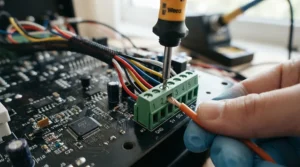
- Wire the relay output across the button terminals. The relay’s common and normally open terminals replace your finger. Don’t connect it to any live feed.
- Power the module separately. A small 12V or 24V supply or a nearby socket keeps the control circuit clean.
- Add a door sensor. A magnetic reed switch on a spare input reports open or closed. Without it, you’re pressing a button blind.
- Join the network. Check Wi-Fi strength in the garage first, because a weak signal causes most “it’s broken” moments.
In your first 30 days, avoid three mistakes: mounting the sensor too far apart, ignoring firmware updates and forgetting to test the door’s safety reversal. After setup, run ten open-close cycles and watch for hesitation.
Real-World Scenarios: Which Smart Relay Module for Garage Door Fits Your Household
Specs only help once you picture your own driveway. Here are three profiles, matched to products with reasoning.
The Apple household with one door. Imagine a family of four in a semi with an integral garage, a mixed iPhone household and zero appetite for wiring. The Meross MSG100HK suits them best: native HomeKit, an included sensor and alerts when the door is left open at bedtime. Budget is modest and use is daily.
The Home Assistant enthusiast with a detached garage. Picture a keen tinkerer who already runs local automations and wants everything on their own network. The Shelly 1 Gen3 fits perfectly, with MQTT and cloud both available. If space inside the opener is tight, the Shelly 1 Mini Gen3 is the neater alternative.
The double-garage Aqara owner. Think of a household with two sectional doors and an Aqara hub already in a hallway. The Aqara Dual Relay Module T2 gives two relays in one unit and ties into HomeKit through the hub. That saves buying two separate modules.
✨ Don’t Miss These Exclusive Deals!
🔍 Take your garage door automation to the next level with these carefully selected modules. Click on any highlighted product name to check current pricing and availability. These picks will help you build reliable, convenient remote garage access your whole family will actually use!
Problem → Solution Guide for Garage Door Automation
Even good hardware throws up the odd gremlin. These are the five most common problems and their fixes.
The app says the door is open when it’s closed. Check the sensor gap first. Meross’s own troubleshooting covers this scenario, and the usual cause is misalignment or a damaged wire. Reseat the connectors and re-test.
The door won’t respond at all. Bridge the opener’s button terminals manually. If nothing happens, the opener may need an accessory interface or a different input, so consult the manual.
The relay clicks but the door ignores it. The pulse may be too short. In Aqara Dual Relay Module T2 terms, switch to the pulse mode; with Shelly devices, adjust the output timing so the contact stays closed long enough.
Wi-Fi drops in the garage. Brick walls and metal doors are notorious signal killers. Add a mesh node, or consider Zigbee, whose mesh repeats through nearby mains devices.
Notifications pile up and you start ignoring them. Limit alerts to genuinely useful events, such as “open longer than 20 minutes” or “open overnight”.
The pattern is clear: nearly every fault traces back to power, signal or sensor placement, not the relay itself.
What Is a Smart Relay Module for Garage Door Control, and How Does a Dry Contact Relay Work?
A smart relay module for garage door control is a network-connected switch that replaces your finger on the wall button. Inside is an ordinary relay: a coil energises, and a pair of metal contacts closes. With a dry contact relay, those contacts are electrically separate from the module’s own power, so the opener’s control circuit sees only a momentary short.
Think of it as a very polite robot finger. It doesn’t push current into the opener, and the opener doesn’t need to know anything about Wi-Fi.
Two behaviours matter. A pulse closes the contacts briefly, like a tap, which is how most single-button openers work. A latching or on-off mode holds them closed, which suits openers with separate open and close inputs. Products such as the Aqara Dual Relay Module T2 let you pick, while the Sonoff MINI-D offers normally open and normally closed wiring.
Smart relays also add scheduling, scenes and voice assistants. That’s the heart of garage door automation: the opener stays mechanical and dependable, while the intelligence lives in a cheap, replaceable box.
How to Choose a Smart Relay Module for Garage Door Use
Choosing the right smart relay module for garage door duty comes down to six checks.
- Confirm dry contact output. It must be volt-free, so it triggers the opener without feeding it power. Anything else risks damage.
- Match the protocol to your home. Wi-Fi needs no hub, Zigbee needs a hub like Aqara’s, and Matter gives cross-platform flexibility.
- Check current rating and mode. A 2A relay such as the Sonoff MINI-D is fine for signalling, but not for switching loads.
- Plan for door status. A relay alone can’t tell whether the door is open. Pick a unit with a sensor input or a bundled sensor like the Meross MSG100HK.
- Count your doors. Two doors favour a dual-relay unit, while one door suits any single-channel module.
- Check long-term support. New UK rules require basic security for consumer smart devices, and Which? explains the new security laws for smart devices in plain English. Prefer brands that publish update commitments.
If you’re unsure, start with the Shelly 1 Gen3 for DIY or the Meross MSG100HK for plug-and-play.
Dry Contact Relay vs Wet Contact: Why It Matters for Garage Door Automation
If there’s one concept worth understanding, it’s the difference between a dry contact relay and a wet one. Get this wrong and you could damage your opener.
A wet contact switches a live feed. It passes mains or low-voltage power through the relay to a load, like a lamp. A dry contact relay merely connects two terminals without supplying power, so the opener supplies its own tiny signal voltage and the relay closes the loop.
Garage openers overwhelmingly expect the second. Their button terminals carry a few volts, and applying mains there is a recipe for a dead circuit board. This is why modules such as the Aqara Dual Relay Module T2 let you convert wet to dry by removing a jumper, and why the Shelly 1 Gen3 is popular: its output is independent of its supply.
A practical rule: if the opener’s manual describes a “volt-free” or “potential-free” input, you need a dry contact relay. If you can’t tell, test the terminals with a multimeter or ask an electrician. It’s a five-minute check that saves an expensive mistake.

Smart Relay Module vs Full Smart Opener: Which Wins?
Should you retrofit a smart relay module for garage door control, or bin the opener altogether? It depends on what the existing motor is doing.
| Option | Typical outlay | Keeps existing opener? | Door status feedback | Best For |
|---|---|---|---|---|
| Dry contact relay such as Shelly 1 Gen3 | Lowest | Yes | With a sensor | Healthy openers, DIYers |
| Kit such as Meross MSG100HK | Low | Yes | Included | Beginners wanting simplicity |
| Full smart opener replacement | Several hundred pounds | No | Built in | Failing or noisy openers |
The table tells a clear story. If your motor is quiet, reliable and fitted with safety features, a relay is the obvious economy. If it’s rattling, slow or obsolete, then money spent on a retrofit is money you’d regret. Also consider that a new opener comes with current-generation safety hardware, which a retrofit can’t add.
My verdict: retrofit unless the opener is genuinely failing. You keep proven mechanics and add the clever bit for the price of a sandwich.
Remote Garage Access: Security, Wi-Fi and Staying Safe
Remote garage access is the headline benefit, and also the main thing to get right. A garage door is a physical entry point, so the digital side deserves attention.
The NCSC’s guidance on using smart devices safely at home advises choosing strong passwords, installing updates promptly, and switching off remote access if you don’t need it. That last tip is worth taking seriously: if you only ever operate the door from your driveway, local-only control through Matter or a local API removes an entire attack route.
In the UK, consumer smart devices must now meet basic security requirements under the PSTI regime, which began applying on 29 April 2024. That’s reassuring, but it doesn’t replace your own housekeeping.
Practical habits for safe remote garage access:
- Use a unique password and enable two-step verification on the manufacturer’s account.
- Turn on “door left open” alerts.
- Keep the module on a separate guest or IoT network where your router allows it.
- Don’t share app access casually.
A garage that anyone with a stolen phone can open is worse than the manual remote it replaced, so design for the bad day, not the good one.
Features That Actually Matter (And Those That Don’t)
Marketing pages shout about everything. Here is what genuinely matters when you buy a smart relay module for garage door duty.
Matters:
- Isolated dry contact output. Non-negotiable.
- A sensor input. Knowing the door’s state is what turns a button into garage door automation.
- Local control. If the cloud vanishes, you still want to open your door. MQTT, Matter and local APIs help.
- Pulse timing control. It lets you tune the contact to your opener.
Doesn’t matter:
- Huge current ratings. A 16A relay doesn’t make the door open faster.
- Energy monitoring. A button circuit uses almost nothing.
- Fancy colour LEDs. Hidden above your car, nobody sees them.
Voice control is nice but needs a rule: never let a voice assistant close the door when you can’t see it. A relay doesn’t know a child, pet or bicycle is in the way, so convenience must be matched to common sense.
Safety, Regulations and Compliance for Powered Garage Doors
A retrofit relay doesn’t change your door’s mechanical safety, but it does change how and when the door moves. That makes safety context important.
The Health and Safety Executive has published a safety alert on revised standards for powered doors, gates and barriers covering BS EN 12453:2017 and BS EN 12604:2017. These set safety requirements for power-operated garage doors and gates, and the alert notes that machinery such as powered doors must be safe under the Supply of Machinery (Safety) Regulations 2008. Those rules mostly bind installers and duty holders, but the principle applies at home: don’t defeat obstruction detection or photocells.
Practical takeaways:
- Don’t bypass safety devices. A relay should only replace the button, never the opener’s own protections.
- Prefer visible closing. If you close remotely, make sure you can see the door or that your opener sounds a warning first. Check your manual for what it provides.
- Look for UKCA or CE marking on the module, as radio equipment sold in the UK must meet the relevant requirements.
- Use a competent electrician for any mains wiring, in line with the wiring rules that apply to domestic installations.
Treat the relay as a remote finger, never as a safety system.
Long-Term Cost and Maintenance of Garage Door Automation
Upfront cost is only half the story. Here’s how the total cost of ownership shapes up.
| Product | Ballpark outlay | Extras you may need | Value verdict |
|---|---|---|---|
| Shelly 1 Gen3 | £10-£15 | Reed sensor, small supply | Excellent |
| Shelly 1 Mini Gen3 | £10-£15 | Reed sensor | Excellent |
| Sonoff MINI-D | £10-£15 | Sensor, supply | Excellent for signal duty |
| Aqara Dual Relay Module T2 | £30-£40 | Aqara hub, sensors | Good, better with a hub |
| Meross MSG100HK | £25-£40 | USB socket | Very good for beginners |
| Shelly Plus 1 | £12-£20 | Sensor, supply | Good if in stock |
| Sonoff SV | Under £10 | Supply, time | Great for hobbyists |
The analysis is straightforward: nearly all of these cost less than a single replacement remote from some opener manufacturers. Add a few pounds for a reed switch and a small power supply and your total stays modest.
Maintenance is light. Once a quarter, check the sensor alignment, test the app trigger, and apply firmware updates. Once a year, re-verify that your opener’s safety reversal still works. Over several years the relay’s cost-per-use rounds to pennies, which is why this route usually beats replacement.

Frequently Asked Questions
❓ Can I use a smart relay module for garage door control with any opener?
❓ Do I need a dry contact relay, or will a normal smart switch do?
❓ How much does garage door automation cost in the UK?
❓ Will remote garage access still work if my Wi-Fi goes down?
❓ Is it safe to close the garage door remotely?
Conclusion
After weighing the specs, the sensors and the owner feedback I could verify, here’s where I’d land.
For most DIY-minded UK households, the Shelly 1 Gen3 is the best smart relay module for garage door duty: isolated output, flexible power, and local control. If your opener’s housing is cramped, the Shelly 1 Mini Gen3 solves the space problem. Beginners who want status alerts without touching a screwdriver should pick the Meross MSG100HK, and Aqara households with two doors will love the Aqara Dual Relay Module T2. The Sonoff MINI-D is the thrifty signal-only option, the Shelly Plus 1 is a capable older sibling if you find stock, and the Sonoff SV is for tinkerers.
Whatever you choose, remember three rules: use a true dry contact relay, add a door sensor for status, and protect your account like the front door it effectively is. Do that, and you get garage door automation and remote garage access for the price of a pub lunch.
✨ Ready to upgrade?
🚗 Click any highlighted product name above to check current pricing and availability, then give your garage door the smart brain it deserves! 🔌
Recommended for You
- Smart Dimmer Switch: 7 Best Picks For UK Homes (2026)
- No Neutral Smart Switch: 7 Best Picks For UK Homes (2026)
- Smart Relay Module: 7 Best Picks For UK Homes (2026)
Disclaimer: This article contains affiliate links. As an Amazon Associate, I earn from qualifying purchases. If you purchase products through these links, we may earn a small commission at no additional cost to you.
✨ Found this helpful? Share it with your friends! 💬🤗
