

In This Article
Unscrew the plate on a typical British light switch and you’ll meet an awkward truth: two wires, an earth, and no blue neutral in sight. That gap is why so many smart switches look brilliant in the product photos and refuse to work on your wall. A no neutral smart switch is built for exactly this predicament, and in 2026 the category has grown up from “one dodgy import and a prayer” into a properly competitive market.

Here’s the problem in one breath. In older wiring, the neutral runs to the ceiling rose, not the switch, so the neutral wire requirement of a standard smart switch simply can’t be met without chasing plaster. The clever workaround is to borrow a whisper of current through the lamp itself. Clever, yes. It’s also the origin of the flickering LED issue that fills forum threads. We’ll tackle both.
One honest note before we start: I haven’t wired any of these into my own hallway. Everything below rests on manufacturer specifications, UK retailer listings and the recurring themes in real owner reviews, which I flag as aggregated sentiment wherever it appears. Most of the picks use Zigbee, a low-power mesh radio standard, so a hub features often, and I’ll say clearly where it doesn’t.
You’ll get seven researched picks, a close look at every smart switch under £30, and a practical fix list for older wiring. Prices are ranges only, so check the current price before you buy.
No Neutral Smart Switch Quick Comparison
| Product | Type | Hub needed? | Approx. price range | Best For |
|---|---|---|---|---|
| Tapo S220 | Battery-powered 2-gang rocker | Yes (Tapo H100/H200, extra) | Around £20-£30 | Budget two-gang hallways |
| MOES Zigbee Smart Wall Switch | 1-gang Zigbee rocker | Zigbee hub/coordinator | Mid-£20s | Hub-owning tinkerers |
| SONOFF ZBMINIL2 | Zigbee module behind your switch | Zigbee hub/coordinator | Around £15-£25 | Tiny, shallow back boxes |
| Shelly 1L Gen3 | Wi-Fi/Matter relay, bypass included | No | Likely £20-£35 | People who hate hubs |
| Aqara Smart Wall Switch H1 | Zigbee 3.0 metal-frame rocker | Aqara hub | Around £35-£45 | Polished, double-rocker looks |
| Aqara Single Switch Module T1 | Zigbee 3.0 module | Aqara hub | Around £25-£30 | Existing Aqara households |
| Candeo C-ZB-DM204 | Zigbee dimmer module | Zigbee hub/coordinator | Likely £30-£45 | Dimmable, mood lighting |
Read across the table and a pattern jumps out. The cheapest routes (SONOFF ZBMINIL2, Aqara Single Switch Module T1 and the MOES Zigbee Smart Wall Switch) lean on a hub, while Shelly 1L Gen3 is the only pick that skips one entirely. If you already own an Aqara or Tapo hub, your shortlist practically writes itself; if you own nothing, count the hub as part of the price. Anyone with staircase switching should read the scenarios section before ordering.
💬 Just one click — help others make better buying decisions too!😊
Top 7 No Neutral Smart Switch Picks: Expert Analysis
Each pick below gets the same treatment: what the specs mean in practice, who it suits, what real reviewers keep saying, and what it costs.
1. Tapo S220 — cheapest route to a two-gang hallway
The Tapo S220 wins on economics: a two-gang faceplate that swaps in for your existing switch and dodges the neutral problem by running on two AAA batteries. It needs a back box at least 25 mm deep and pairs with a Tapo H100 or H200 hub, sold separately.
Because the power comes from batteries rather than a trickle through your lamp, the flickering LED issue shouldn’t bite in the same way; that’s reasoning from how TP-Link describes the design, not a lab result. It’s a one-way switch, so staircases are out. It suits renters-with-permission and hall-and-landing pairs where two circuits need smartening on a budget.
Reviewers describe it as easy to fit and simple to set up in the Tapo app, though one UK review found the depth awkward in a crowded back box, and the manual switch stops responding when the batteries die. Another UK reviewer noted that switch plus hub still undercut the Aqara equivalent.
Pros:
- ✅ No bleed current, so no glow worries
- ✅ Two gangs in one faceplate
- ✅ Alexa and Google Assistant support
Cons:
- ❌ Batteries need replacing eventually
- ❌ One-way only; hub sold separately
Price range: switch around £20-£30, hub extra. Genuine value if you’d buy a Tapo hub anyway.
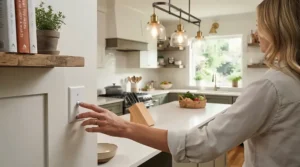
2. MOES Zigbee Smart Wall Switch — no-frills Zigbee for the mid-£20s
The MOES Zigbee Smart Wall Switch is the pick for anyone already running Zigbee2MQTT or ZHA who refuses to pay premium-brand money. It’s a one-gang rocker that swaps into your wall box and, in its no neutral version, needs only live and switched live.
The catch: like most no neutral designs it relies on standby current through the lamp, so minimum load and LED choice matter. In practice that means it’s happiest on decent branded bulbs and grumpier on bargain-bin ones. Think of it as a tinkerer’s value play rather than a polished, warranty-backed appliance.
On sentiment, one UK Zigbee roundup listed a related MOES wall switch with a mid-4s rating from a little over a hundred ratings, but I couldn’t verify a comparably large review pool for the strict no neutral variant. Read current Amazon UK reviews carefully, and make sure you buy the listing labelled no neutral, since MOES also sells neutral-optional versions.
Pros:
- ✅ Squarely inside smart switch under £30 territory
- ✅ Works with Zigbee2MQTT and ZHA
- ✅ Familiar rocker in a standard wall box
Cons:
- ❌ Thinner verified review pool
- ❌ Fussier with cheap LED bulbs
Price range: around the mid-£20s. Fair value if you already own a Zigbee coordinator.
3. SONOFF ZBMINIL2 — tiniest module, gentle on low-wattage LEDs
The SONOFF ZBMINIL2 is a Zigbee relay measuring roughly 39.5 x 32 x 18.4 mm, small enough to slip behind your existing switch even in shallow boxes. SONOFF says it copes with loads as low as 3W without an anti-flicker module, and it’s rated for 6A.
Two caveats matter. It’s a Zigbee end device, not a router, so it won’t strengthen your mesh. And it reportedly won’t pair with the Hue Bridge, so check your hub first. Based on the specs, it’s the sensible answer for older wiring with modest LED loads and a Home Assistant setup, where a dongle replaces any SONOFF hub.
Reviewers repeatedly praise its stability: one UK-based reviewer reported months without drop-outs after abandoning a Shelly 1L. Not everyone escapes the glow, though; one SmartThings user saw part of an LED flood light stay lit when off, and another review says very low-wattage bulbs may need SONOFF’s separate bypass.
Pros:
- ✅ Fits shallow, cramped back boxes
- ✅ Handles very low-wattage LED loads
- ✅ Keeps working when the internet drops
Cons:
- ❌ Not a Zigbee router
- ❌ Won’t pair with the Hue Bridge
Price range: around £15-£25. Outstanding value for a smart switch under £30 build.
4. Shelly 1L Gen3 — Wi-Fi and Matter with no hub
The Shelly 1L Gen3 is the hub-averse person’s answer. It connects straight to Wi-Fi, is Matter-ready, and works with only a live wire, supporting up to 200W at 240V. The bypass is included in the pack, which matters because Shelly says LED loads need it to keep current flowing. That bundled bypass is a quiet advantage in the flickering LED issue fight; you’re not hunting for a part later. The 200W ceiling is generous for one room, and Gen3 devices carry a three-year warranty. It suits Home Assistant users too, with native integration and no cloud account required, according to one UK roundup. Sentiment is mixed rather than rosy: the best-known criticism I found is a single reviewer in a rental who reported Shelly 1L drop-outs and switched to Zigbee. One anecdote isn’t a verdict, but Wi-Fi congestion in packed flats is worth weighing.
Pros:
- ✅ No hub or bridge required
- ✅ Bypass included in the box
- ✅ Three-year Gen3 warranty
Cons:
- ❌ Wi-Fi reliability depends on your router
- ❌ Bulkier fitting than tiny Zigbee modules
Price range: likely £20-£35; verify current pricing. Strong value if you dislike hubs.
5. Aqara Smart Wall Switch H1 — polished metal frame, double-rocker option
The Aqara Smart Wall Switch H1 in its no neutral form is the tidy choice for anyone who wants their smart switch to look like a proper one. It needs an Aqara Zigbee hub, offers single and double rockers, and installs within roughly a 30 mm depth. Aqara’s own FAQ says each load should be at least 3W for LED lamps, and warns that below that threshold it may flicker when off. It also says mainstream lamps behave better than copycat brands, which may flicker or even crash the switch. That’s refreshing candour, and a clear signal about how to shop for bulbs. Pair it with the wireless Aqara Smart Wall Switch H1 remote for two-way upgrades. One UK reviewer picked it for reliability, safety and ease of install, and another called it the only double-rocker no neutral option they’d found.
Pros:
- ✅ Sturdy metal frame feels premium
- ✅ Double-rocker no neutral version available
- ✅ Wireless remote enables two-way control
Cons:
- ❌ Aqara hub required
- ❌ Fussy about low-wattage or cheap LEDs
Price range: around £35-£45. Better value if you already run an Aqara hub.
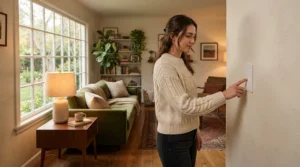
6. Aqara Single Switch Module T1 — compact module for Aqara households
The Aqara Single Switch Module T1 (No Neutral) hides behind your existing switch, so you keep your faceplate and swap only the guts. It uses Zigbee 3.0, needs an Aqara hub, is CE and RoHS certified per Amazon UK’s listing, and carries a two-year warranty. A comparison site notes a 1250W/5A resistive ceiling for the no neutral version, and that it lacks the router role and energy monitoring of its with-neutral sibling. For a bedroom or hallway, 1250W is comfortably enough. Aqara’s own UK shop strongly recommends a professional electrician, since incorrect wiring can burn the module out, which is worth heeding. It supports two-way setups through a wireless switch. I found little independent review depth beyond retailer and comparison pages, so treat this as a spec-led recommendation, not a crowd verdict.
Pros:
- ✅ Keeps your existing faceplate
- ✅ 1250W resistive ceiling is ample
- ✅ Two-way support via wireless switch
Cons:
- ❌ Not a Zigbee router
- ❌ Independent review depth is thin
Price range: around £25-£30. Good value for smart switch under £30 hunters with an Aqara hub.
7. Candeo C-ZB-DM204 — dimming without the neutral
The Candeo C-ZB-DM204 is the only dimmer here, and dimming is where no neutral setups usually struggle. Candeo’s product page describes trailing-edge dimming for LED and halogen (up to 200W LED, 400W halogen on the C204 listing), adjustable minimum and maximum brightness, and push-retractive switches for two-way control. Amazon UK’s listing adds energy monitoring and says it works with or without a neutral, which is handy if you renovate later. Trailing-edge dimming is the gentler method for LED drivers, so it usually plays nicer with dimmable bulbs. Candeo’s newer Candeo RD1 rotary dimmer works as a Zigbee router and fits standard 35 mm UK boxes. Candeo also claims its earlier rotary dimmer was the UK’s best-selling; that’s the brand’s own claim, and I couldn’t verify independent review volume, so lean on the specs and check current Amazon UK feedback.
Pros:
- ✅ Genuine dimming with no neutral needed
- ✅ Adjustable minimum and maximum brightness
- ✅ Works with a wide range of Zigbee hubs
Cons:
- ❌ Needs dimmable, compatible LED bulbs
- ❌ Pricier than plain on/off modules
Price range: likely £30-£45. Worth the premium if dimming matters to you.
What Is a No Neutral Smart Switch?
A no neutral smart switch is a Wi-Fi, Zigbee or battery-powered light control that works with only a live and switched-live wire at the wall box. Instead of using a neutral return, it either leaks a tiny standby current through the light fitting or runs on batteries, letting older UK homes go smart without rewiring.
That definition hides three distinct families, and knowing which you’re buying saves grief. Bleed-current designs, such as the Aqara Smart Wall Switch H1 and SONOFF ZBMINIL2, keep their radio alive by passing a minuscule current through the lamp. Battery designs, like the Tapo S220, don’t touch the lamp for power at all. And bypass-assisted relays, such as Shelly 1L Gen3, ship with a small component to keep low-wattage LEDs happy. Each approach has trade-offs: bleed-current models are compact and mains-powered but sensitive to bulb choice, while batteries mean occasional maintenance.
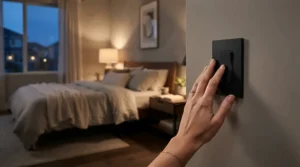
Neutral Wire Requirement: Why Older Wiring Leaves You Stranded
The neutral wire requirement exists because a smart switch is really a tiny computer with a radio, and it needs power around the clock, even when the light is off. A dumb switch just opens and closes a gap. A smart one has to stay awake, listening for your phone, and that means a return path for current.
Traditional UK lighting runs a live and switched live to the wall, with the neutral going straight to the ceiling rose. That’s why so many older wiring layouts, particularly in homes built before the 2000s, leave a smart switch without its lifeline. Don’t trust wire colours to tell you what’s what, either; in older homes, colours don’t always prove function, and one electrician’s guide warns that both conductors in a standard switch drop are live, so forcing one onto a neutral terminal creates a fault, not a circuit.
If you’re renovating and the walls are open anyway, pull a neutral to every switch drop. It’s cheap insurance. If a neutral does exist at your switch, a with-neutral model is generally more reliable and can act as a Zigbee router. For everyone else, the neutral wire requirement is precisely why this category exists.
How to Choose a No Neutral Smart Switch
Picking well is mostly about matching the product to your wiring, bulbs and hub, not chasing features.
- Confirm what’s in the back box. Isolate the circuit at the consumer unit and check for a neutral before ordering; if you’re unsure, ask a qualified electrician.
- Count your gangs and ways. Note whether your light is controlled from one place or two; the Tapo S220 is one-way only, while modules like SONOFF ZBMINIL2 advertise two-way control.
- Check minimum load. Aqara says each load on its no neutral wall switch should be at least 3W, and SONOFF ZBMINIL2 claims 3W; add up your bulbs.
- Pick your protocol and hub. Zigbee needs a hub or coordinator, Wi-Fi models like Shelly 1L Gen3 don’t, and the Tapo S220 needs a Tapo hub.
- Measure back-box depth. The Tapo S220 wants at least 25 mm, the Aqara Smart Wall Switch H1 sits within about 30 mm, and Candeo RD1 models fit standard 35 mm boxes.
- Decide switch, module or dimmer. Modules keep your faceplate, rockers replace it, and a dimmer like Candeo C-ZB-DM204 adds brightness control.
- Buy from a reputable seller. Electrical Safety First advises buying smart devices only from reputable retailers or manufacturers, since fakes can be dangerous, and planning a manual fallback for when the system fails.
Flickering LED Issue: Why It Happens and How to Fix It
The flickering LED issue is the price of admission for many no neutral designs. That standby current has to go somewhere, and efficient LED drivers sometimes react by glowing faintly or blinking. Here’s how to tackle the common symptoms.
Problem 1: faint glow when the light is “off”. Add a bypass (a small component wired in parallel across the load at the fitting). Shelly 1L Gen3 includes one; for SONOFF ZBMINIL2, reviewers say SONOFF sells one separately.
Problem 2: flicker at low wattage. Check your total load. Aqara’s FAQ says Aqara Smart Wall Switch H1 loads below its minimum may flicker when off, so combine bulbs or choose a slightly higher-wattage LED.
Problem 3: random flashing or switch crashes. Aqara says copycat lamps with poor driver design may flicker or even crash its switch. Swap to mainstream-brand bulbs first; it’s the cheapest experiment.
Problem 4: dimming misbehaves. Use genuinely dimmable LEDs with a trailing-edge dimmer such as Candeo C-ZB-DM204.
Problem 5: none of the above works. Switch approach entirely: a battery model like Tapo S220 avoids the bleed current, or move the relay to the ceiling rose where a neutral exists. Fitting a bypass means opening the ceiling rose, so involve a competent electrician.
Smart Switch Under £30: What You Actually Get
A smart switch under £30 is realistic in 2026, but the sticker price hides a hub. Here’s how the cheap end really compares.
| Product | Approx. price range | What’s extra to buy | Best For |
|---|---|---|---|
| SONOFF ZBMINIL2 | Around £15-£25 | Zigbee hub or dongle | Cheapest entry with Home Assistant |
| Aqara Single Switch Module T1 | Around £25-£30 | Aqara hub | Aqara households |
| MOES Zigbee Smart Wall Switch | Mid-£20s | Zigbee hub or coordinator | Value-minded tinkerers |
| Tapo S220 | Around £20-£30 | Tapo H100/H200 hub, batteries | Two-gang hall lights |
The winner on pure price is SONOFF ZBMINIL2, but only if you already own or will happily buy a Zigbee coordinator. Tapo S220 looks cheap until you add the hub, though one UK reviewer found switch plus hub still cost less than an Aqara switch alone. The honest advice: decide your ecosystem first, then hunt the smart switch under £30 within it.
Practical Usage Guide: Your First 30 Days
Fitting a no neutral smart switch is straightforward on paper and fiddly in a real back box. Here’s a sensible sequence.
Day 0: prepare. Isolate the circuit at the consumer unit, prove it dead, and photograph the existing wiring before touching anything. In England, electrical work in homes falls under Part P of the Building Regulations, so if the job involves more than a like-for-like swap, call a registered electrician.
Day 1: fit and pair. Follow the manufacturer’s diagram exactly. Pair the device with your hub or app, then test every bulb in the room.
Week 1: tune. Set minimum brightness on dimmers like Candeo C-ZB-DM204, and watch for any glow or flicker after dark, when it’s easiest to spot.
Week 2: create a fallback. Electrical Safety First advises having a manual light for when the system fails. Keep a lamp within reach and note your hub login details somewhere safe.
Day 30: check in. Update firmware, confirm nothing feels unusually warm or sounds buzzy, and replace Tapo S220 batteries if the app warns you.
Common first-month mistakes: buying before checking for a neutral, ignoring back-box depth, and mixing cheap unbranded LEDs with a fussy switch. Avoid those three and you’ll dodge most of the grief.
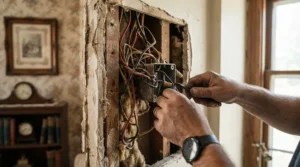
Real-World Scenarios: Three UK Homes
The rented Victorian terrace. A couple with a hallway and landing, a £50 budget and permission from their landlord to swap two switches. Lights are on for a few hours daily, mostly LEDs. The Tapo S220 fits: batteries sidestep bleed-current worries, and the two-gang plate covers both circuits. The catch is one-way wiring, so staircase two-way switching is off the table.
The 1960s semi with a staircase. A Home Assistant fan with cheap LED bulbs and a two-way landing light. The SONOFF ZBMINIL2 suits the hub-owner budget, and it advertises two-way control. Two-way and intermediate wiring is where mistakes multiply, so hire an electrician for that circuit. Swap the cheapest bulbs first; they’re the likeliest source of the flickering LED issue.
The refurbished 1930s living room. A family wanting dimmable downlights, a mood-lighting scene and a sleek finish. Candeo C-ZB-DM204 handles the dimming without a neutral, while an Aqara Smart Wall Switch H1 double rocker could run the adjacent kitchen circuits if they already own an Aqara hub. Budget: roughly £100-£150 including hub.
And for anyone who simply hates hubs, Shelly 1L Gen3 turns any single lighting circuit smart over Wi-Fi with the bypass already in the box.
No Neutral Smart Switch vs Smart Bulbs vs Ceiling-Rose Relays
Smart bulbs, ceiling-rose relays and a no neutral smart switch all make light “smart”, but they behave very differently on a Tuesday night when Wi-Fi drops.
| Option | Wiring work | Wall switch still works? | Best For |
|---|---|---|---|
| No neutral smart switch, such as Aqara Smart Wall Switch H1 | Swap at the wall box | Yes, and it stays smart | Older wiring, family homes |
| Smart bulbs with a normal switch | None | Only if left on, otherwise the bulb loses power | Lamps and renters |
| Relay at the ceiling rose | Needs access to the fitting, with a neutral | Yes, with your existing switch | Homes where the ceiling is accessible |
| Tapo S220 (battery) | Swap at the wall box | Yes, until batteries die | Renters with permission |
Smart bulbs are the simplest fix, but a wall switch flicked “off” kills the bulb’s smarts, which quickly becomes the family’s least favourite habit. A no neutral smart switch keeps the familiar wall control and the smart features in one place. Ceiling-rose relays are elegant where you can reach them, though that means more work above your head.
Safety, Part P and UK Rules Before You Touch a Screwdriver
Safety here isn’t box-ticking; it’s the difference between a tidy upgrade and a call-out. Approved Document P covers the safety of electrical installation work in dwellings, not how well a system functions, and only new or altered work must meet current standards. In England, swapping a like-for-like switch is commonly treated as non-notifiable minor work, but rules differ across Wales, Scotland and Northern Ireland, and anything beyond a straight swap can change that. This is general information, not professional advice.
Practical rules of thumb:
- Isolate at the consumer unit and prove the circuit dead.
- Check the CE or UKCA marking, and avoid unbranded marketplace listings.
- Follow the manufacturer’s wiring diagram, not a wire-colour hunch.
- Hire a registered electrician for two-way, intermediate or anything you can’t identify.
Aqara’s UK shop itself recommends a professional electrician for its Aqara Single Switch Module T1, warning that wrong wiring can burn it out. Take that seriously.
Long-Term Cost & Maintenance
The real cost of a no neutral smart switch isn’t the switch, it’s the ecosystem. Five modules at £15-£25 each land around £75-£125 before a hub, so a shared hub quickly becomes the deciding factor. Batteries add a small running cost for Tapo S220, and hubs occasionally get discontinued, so one electrician’s blog warns of a “graveyard” of abandoned hubs; favour open standards like Zigbee and Matter.
On durability, Shelly 1L Gen3 carries a three-year Gen3 warranty and Aqara Single Switch Module T1 two years, per the listings. Mesh health matters too: SONOFF ZBMINIL2 and Aqara Single Switch Module T1 don’t act as routers, whereas Candeo RD1 models do, so place a router device between distant rooms.
Maintenance is light: update firmware, keep spare batteries, and revisit bulb choices if flicker returns. Budget an occasional electrician visit for anything involving the ceiling rose.
Features That Actually Matter (And Those That Don’t)
What matters: minimum-load compatibility (the dull spec that decides your flickering LED issue), back-box depth, local control that survives an internet outage, two-way support if you need it, and a reliable manual fallback. Candeo C-ZB-DM204, for instance, is defined by its dimming quality, not its app.
What doesn’t: flashy LED indicator effects, obscure scene libraries you’ll never open, and “smart” badges without a clear hub plan. Energy monitoring is a nice bonus, but Aqara’s no neutral module lacks it, and it shouldn’t be your deciding factor when the neutral wire requirement is the real obstacle.
Matter support is worth noting where offered, as with Shelly 1L Gen3, but Zigbee reliability and a sane hub plan still trump a logo on the box.
FAQ
❓ Is a no neutral smart switch safe on older UK wiring?
❓ Do I need a Zigbee hub for a no neutral smart switch?
❓ Why does my LED still glow after I switch it off?
❓ Can a no neutral smart switch handle two-way staircase lighting?
❓ What's the cheapest smart switch under £30 that needs no neutral?
Conclusion
Choosing a no neutral smart switch comes down to three honest questions: what’s in your back box, which hub (if any) you already own, and how fussy your bulbs are. If you want the cheapest path into smart lighting on older wiring, SONOFF ZBMINIL2 and Aqara Single Switch Module T1 are the smart switch under £30 heroes, provided you accept the hub. If you’d rather avoid hubs altogether, Shelly 1L Gen3 with its bundled bypass is the neatest answer. For polished looks and double rockers, Aqara Smart Wall Switch H1 leads, while Candeo C-ZB-DM204 is the one for dimming. Tapo S220 is the easy two-gang budget option, and MOES Zigbee Smart Wall Switch is a value play for tinkerers.
Whichever you choose, respect the neutral wire requirement rather than fighting it, treat any flickering LED issue as a bulb-and-bypass problem, and never skip the safety basics. Older wiring doesn’t have to mean a dumb home.
Recommended for You
- Smart Relay Module: 7 Best Picks For UK Homes (2026)
- Smart Light Switch vs Smart Plug: 7 UK Picks Tested (2026)
- In-Wall Smart Switch: 7 Best UK Picks For Every Budget (2026)
Disclaimer: This article contains affiliate links. As an Amazon Associate, I earn from qualifying purchases. If you purchase products through these links, we may earn a small commission at no additional cost to you.
✨ Found this helpful? Share it with your friends! 💬🤗
